
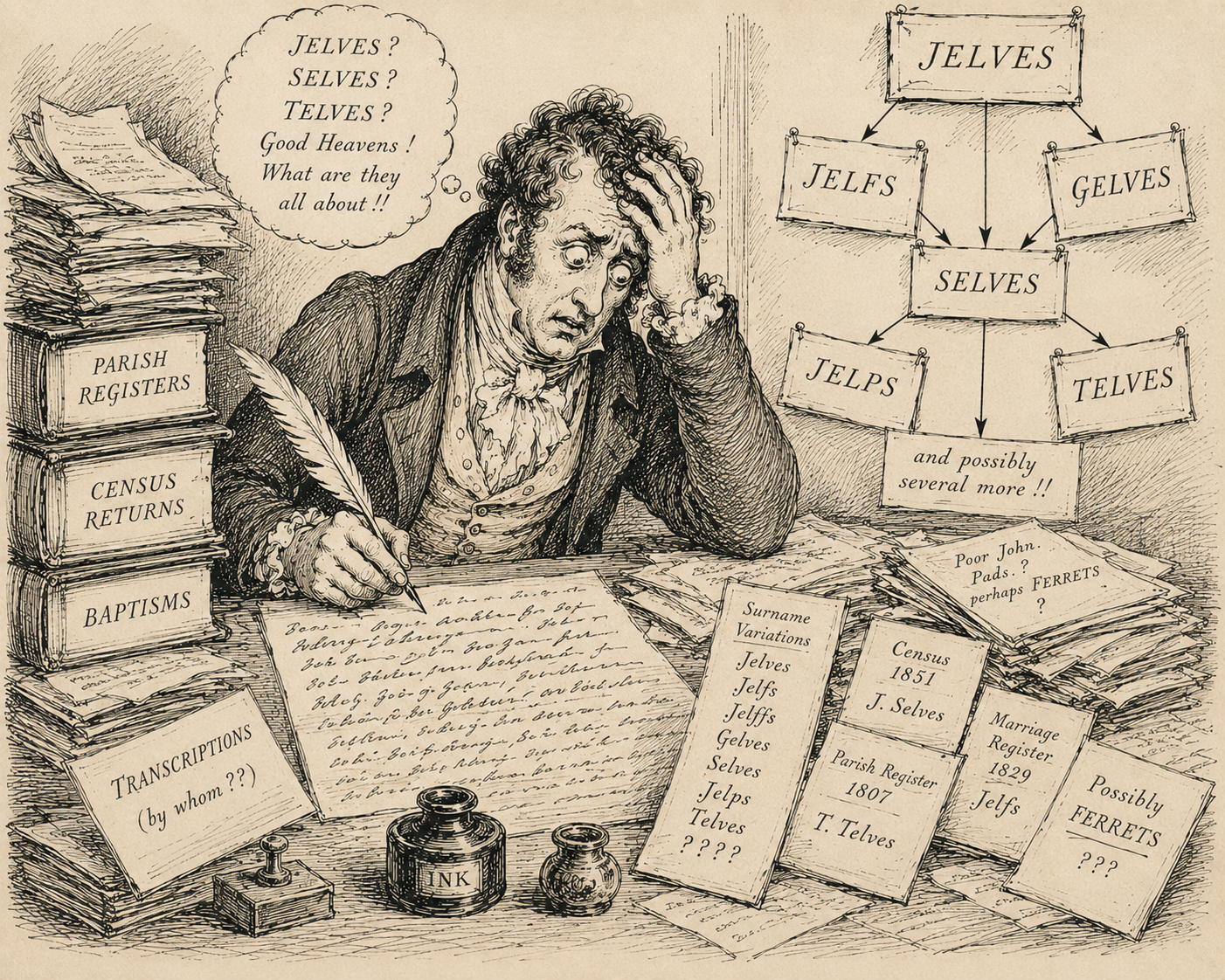
At some point in family history research, almost everyone experiences the moment where an ancestor appears to vanish completely from the records, only to later reappear hiding behind dreadful handwriting, creative spelling, or a transcription error that seems to defy logic entirely. This post explores why surname spellings changed so frequently in historical records, how these variations create entirely artificial brick walls, and the practical ways researchers can begin untangling the chaos.
There are few moments in family history research quite as humbling as confidently searching for an ancestor’s surname, receiving precisely zero results, and then discovering three hours later that the entire family has simply been hiding under a spelling variation apparently invented by a sleep-deprived parish clerk armed with a blunt quill and only a passing interest in consistency.
At some point, every genealogist experiences this descent into madness. You begin as a sensible researcher. Calm, methodical, organised. Then suddenly you are sitting at midnight staring at a census return muttering things like, “Perhaps the W is actually two very tired Vs,” or “That cannot possibly say Telves. Nobody is called Telves.” And yet there they are. Your ancestors. Living perfectly happily in the records under a surname spelling that appears to have been assembled during a minor administrative emergency.
Why Surnames Changed So Frequently
The longer I research family history, the more convinced I become that surnames in the past were treated less as fixed identifiers and more as vague conversational suggestions. Modern life has trained us to expect rigid spelling consistency. The NHS cannot cope if somebody accidentally reverses two numbers in a postcode. Banking apps become deeply suspicious if your signature differs slightly from one written ten years ago. Entire websites refuse to function because you forgot a capital letter in a password. Meanwhile, in the eighteenth and nineteenth centuries, entire families drifted between multiple surname spellings with apparently nobody finding this remotely concerning.

When you start looking at the historical reality, it becomes rather understandable. For much of British history, spelling itself was not standardised in the way we now expect. Even educated people often spelled words inconsistently. Before compulsory education and widespread literacy, many ordinary people could not write their own names at all, which meant records were usually created by whoever happened to be holding the pen that day. Parish clerks, vicars, census enumerators, registrars, tax collectors, employers, schoolteachers, hospital administrators and workhouse officials all contributed to this glorious administrative chaos, and every one of them brought their own handwriting, accent, assumptions and enthusiasm levels into the process.
Accents, Dialects, and Phonetic Spellings
Regional accents played a surprisingly large role. A surname spoken in Warwickshire might sound completely different to somebody from London. Black Country pronunciation could soften consonants dramatically, while rural dialects often altered vowel sounds beyond recognition. Irish, Welsh and immigrant surnames were frequently anglicised into whatever local officials believed they had heard. Crucially, the person recording the information often had no way of verifying it. There was no passport being produced, no birth certificate being cross-checked, and certainly no helpful computer system insisting the surname had already been registered elsewhere. If a labourer gave his name aloud to a census enumerator while standing in a noisy street surrounded by children, factory smoke and general chaos, the result depended almost entirely on what the enumerator thought he heard.
The Jelves Family and the Art of Disappearing
The Jelves family in my own tree have become particularly talented at disappearing in this manner. Over time I have encountered the surname written or transcribed as Jelves, Jelfs, Jelffs, Gelves, Selves, Jelps and Telves. At this point I would not be remotely surprised to eventually discover them recorded somewhere as “possibly ferrets.” What makes this especially frustrating is that not all of these variations originated with the original records themselves. Some are modern transcription issues layered on top of difficult historical handwriting, which is where things become particularly dangerous for family historians.

When Handwriting Becomes the Problem
Nineteenth-century handwriting can be spectacularly unhelpful. Many clerks used elaborate cursive styles filled with loops, flourishes, fading ink and cramped spacing, producing records that look less like writing and more like somebody became overexcited while decorating a wedding invitation. A capital J can easily resemble an S or a T depending on the style of writing. Ink bleeds through pages, letters merge together, and faded strokes quietly disappear over time. So a surname like Jelves can quickly become Selves if the capital J loses its curve, or Telves if the opening stroke looks too angular. Gelves appears when the loop closes oddly, while Jelps emerges because the v and e merge together in a way that confuses both human transcribers and genealogy websites alike.
Once a transcription error enters an online database, it gains a sort of administrative immortality. Thousands of researchers may search unsuccessfully for the correct spelling without ever realising the family is quietly sitting in the records disguised as something entirely different.
Why Transcription Errors Create Brick Walls
There is something uniquely humbling about spending four hours convinced your ancestors vanished from existence, only to discover they were indexed incorrectly because somebody in 1851 had particularly decorative handwriting. I say this with affection, because transcription projects are enormous undertakings and largely completed by volunteers who deserve medals and restorative cups of tea. Nevertheless, family historians do occasionally find themselves staring at indexed records wondering whether the transcriber perhaps worked under candlelight during a small earthquake.

The problem becomes especially frustrating because spelling issues create entirely artificial brick walls. You may believe a family disappeared between census years when in reality the surname simply shifted slightly. A Chaplain family becomes Chaplin. Willson quietly becomes Wilson. Thorogood develops several entirely unnecessary additional consonants before simplifying itself again two decades later. Entire family lines can effectively vanish behind one badly interpreted letter, which means genealogy becomes less about searching names and more about recognising patterns.
How to Search Beyond Exact Spellings
One of the quickest ways to miss records is insisting on exact surname matches. Broad searches are usually far more effective. Wildcards become particularly useful here. Most genealogy websites allow symbols such as * or ? to replace uncertain letters, so searching for something like “Jel*s” may capture multiple variations at once without requiring you to anticipate every imaginative spelling produced across two centuries of record keeping. It also helps enormously to search using everything except the surname itself. First names, approximate birth years, occupations, birthplaces, addresses, spouses and children often remain surprisingly consistent even when surnames do not.
Context matters enormously in genealogy. Families frequently lived near one another for generations, worked in the same trades, witnessed each other’s marriages and baptised children in the same churches. Witnesses reappear as neighbours in census returns. Occupations pass between fathers and sons. Streets remain familiar across decades. Good genealogy often involves stepping sideways rather than forwards, building evidence gradually until the inconsistencies begin forming a coherent picture.
Then there is the strange skill family historians gradually develop over time: historical handwriting interpretation. After enough years researching old records, you begin examining cursive writing with the concentration of a medieval cryptographer. You rotate images, zoom repeatedly, compare letters elsewhere on the page and start analysing whether the clerk formed his Hs aggressively. At some point you inevitably find yourself saying things like, “That is definitely a G because his Js look emotionally unstable,” which is regrettably a completely normal sentence within genealogy circles.
Practical Tips for Breaking Through Spelling Brick Walls
Fortunately, surname spelling chaos does not have to bring research to a complete halt. While variant spellings and transcription errors can create frustrating brick walls, there are several practical strategies that can help reconnect families who are hiding in plain sight within the records.
- Search using wildcards such as * and ?
- Try phonetic variations of surnames
- Remove or swap individual letters
- Search by first names, occupations, birthplaces and addresses instead of surnames alone
- Check original images rather than relying solely on transcriptions
- Compare handwriting across the entire document page
- Keep a running list of surname variations you encounter
- Research siblings and extended family members, not just direct ancestors
- Search geographically nearby parishes and districts
- Consider how local accents may have affected spelling
- Revisit old brick walls regularly with fresh searches
Final Thoughts
Despite all the frustrations, spelling variations do teach an important lesson about family history itself. Our ancestors were not tidy database entries waiting patiently to be discovered. They were real people living in an imperfect administrative world where literacy levels varied enormously and records were often created by strangers interpreting names phonetically. Many people would never even have seen the documents modern genealogists scrutinise so intensely. Their identities shifted slightly through accents, migration, literacy, bureaucracy and simple human error.
So if your ancestors appear to vanish entirely from the records, do not panic immediately. They may simply be waiting for you under a surname spelling so wildly inventive that even they themselves might not have recognised it.




Leave a Reply