
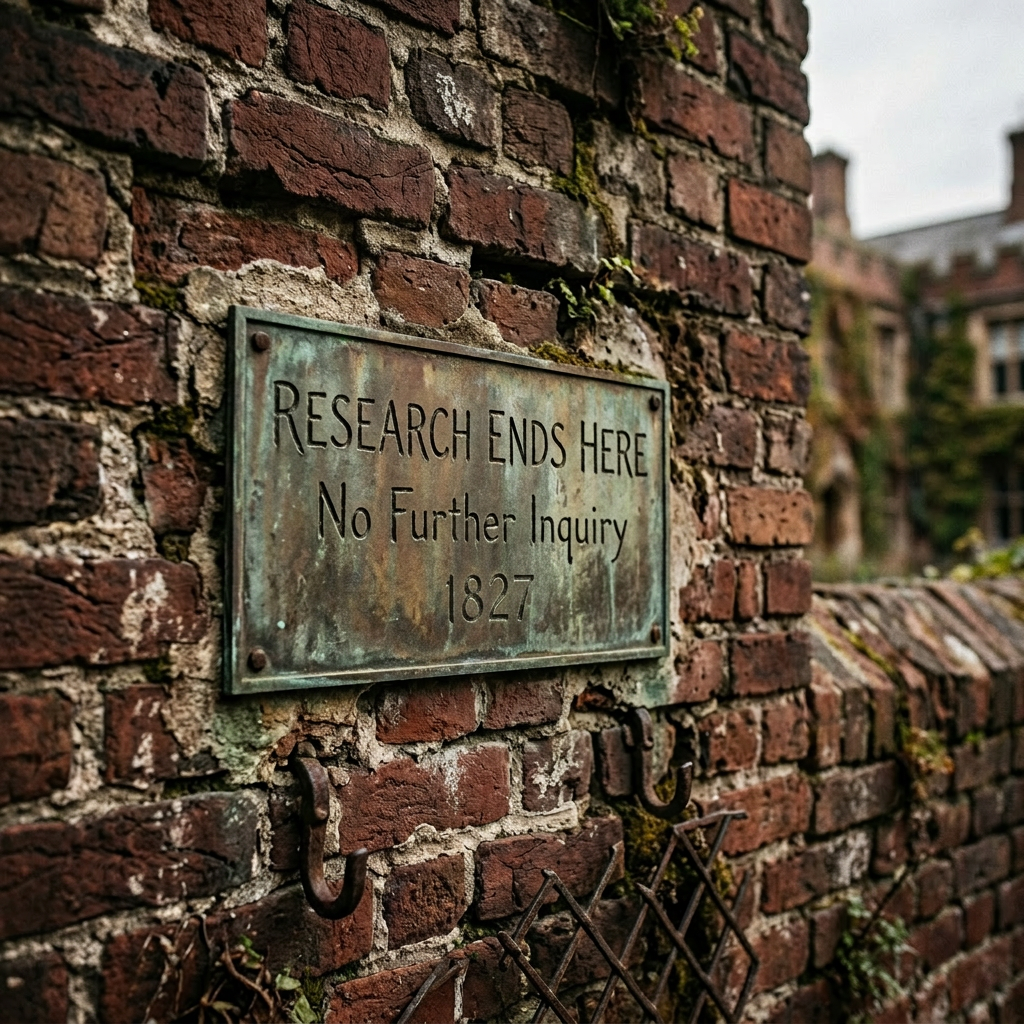
There are few things in family history quite as humbling as making a cup of tea in celebration of an apparent breakthrough, only to spend the next three hours discovering that your ancestor has vanished entirely from the historical record. One moment you are progressing quite happily, collecting census returns, parish register entries and occasional snippets of social history that allow a life to emerge from the records. The next, the trail disappears completely, leaving you staring at a screen and wondering whether your great-great-great-grandparent ever existed at all. Family history has an unfortunate habit of doing this. Just when you begin to feel confident that you know what you are doing, an ancestor vanishes, a record contradicts another record, or a new piece of evidence emerges that forces you to revisit conclusions you thought were settled years ago.
I find myself in precisely this position at the moment. Much of my recent research has centred on my fourth great-grandmother, and what initially appeared to be a relatively straightforward exercise in filling a few gaps has gradually evolved into a much larger investigation. Like many researchers, I began with what seemed to be established facts. My fourth great-grandmother appeared in numerous online family trees, attached to a particular family and supported by records that, at first glance, appeared convincing. The deeper I looked, however, the more uncertain everything became. A baptism in one county appeared to conflict with records in another. A bastardy examination introduced an entirely new potential father. A marriage connected the family to an exciseman, who initially seemed central to the story before gradually becoming a fascinating but largely unrelated mystery in his own right. Each new discovery answered one question while generating three more, which is perhaps the closest thing family history has to a universal law.

Start by Challenging Your Assumptions
Experiences such as these serve as a useful reminder that a brick wall is not always evidence that the records have failed us. Quite often, it is evidence that we have reached the limits of our current understanding and need to look at the problem differently. One of the most valuable lessons genealogy teaches is that certainty should always be approached with caution. It is remarkably easy to mistake repetition for evidence. If enough online trees contain the same information, we naturally begin to assume it must be correct. Yet many of us have experienced the moment when a single original document suddenly causes an entire carefully constructed theory to wobble alarmingly.
Whenever I encounter a dead end, I try to return to the beginning rather than rushing forwards. It is tempting to search for new records in the hope that a breakthrough is waiting somewhere just beyond the next click. More often than not, however, the answer lies hidden within material we have already seen. Dates deserve to be questioned. Places deserve to be questioned. Relationships deserve to be questioned. Even names deserve to be questioned. Anyone who has spent time working with eighteenth and nineteenth-century records will know that our ancestors were often remarkably inconsistent about the information they provided and that the people recording it were not always models of accuracy themselves.
Go Back to the Original Record
Alongside questioning our assumptions, I have become increasingly convinced that one of the most important things a family historian can do is return to original sources whenever possible. Modern genealogy would be almost impossible without indexes and transcripts, and I use them constantly, but they are ultimately somebody else’s interpretation of a record.
Over the past year I have lost count of the number of occasions on which an original document has revealed details that were missing from a transcript or had been interpreted differently by an indexer. More than once I have spent an evening staring at a digitised parish register enlarged to an entirely unreasonable level of magnification, attempting to decide whether a clerk had written one surname or another. In my current quest, several important developments emerged only after examining original images rather than relying on transcriptions. Records that initially appeared straightforward became far more nuanced once viewed in context.
Where possible, there is also enormous value in stepping away from the computer entirely. Some of the most rewarding moments in my own research have come from consulting records held in local archives or making visits to the National Archives. Earlier this year, while researching the exciseman, I found myself examining excise records that added layers of context which would never have been apparent from a simple index entry. There is something profoundly satisfying about sitting in a reading room and handling records that have survived for more than two centuries. Beyond the romance of the experience, however, there is a practical benefit. Original records often contain marginal notes, contextual information or subtle details that disappear entirely when reduced to a transcription or database entry.
Expect Names to Behave Badly
One of the most common causes of apparent brick walls is surname variation. Modern researchers are often conditioned to think of names as fixed identifiers, but our ancestors did not necessarily share that view. Spelling was often fluid, literacy levels varied considerably, and many names were recorded phonetically by whoever happened to be writing them down.
Anyone who has followed one of my family lines will know that I have spent a great deal of time wrestling with surnames that seem determined to reinvent themselves from one generation to the next. Searching creatively, using variant spellings and keeping an open mind about how a name may have been recorded can often transform an impossible search into a successful one. More tips for cracking the code of surname variations is in this Regency Relatives research guide.

Look Beyond the Individual
Another common mistake when faced with a dead end is focusing too intensely on the individual we are trying to find. Family historians sometimes talk about the FAN principle, examining friends, associates and neighbours, and although the name sounds slightly curious, the principle itself is extraordinarily useful.
People did not exist in isolation. They married into families, worked alongside neighbours, appeared as witnesses at one another’s weddings and baptised their children with the help of relatives and friends. Some of the most significant breakthroughs in research have emerged not from the ancestor I was pursuing but from somebody standing beside them in the records. A witness, a bondsman, a neighbour or a sibling can sometimes reveal connections that the principal individual never does.
Think About Movement
We often unconsciously assume that people remained close to where they were born, yet many of our ancestors were remarkably mobile. Employment opportunities, military service, apprenticeship, marriage, poverty and simple necessity could all result in relocation.
Looking back across my own family lines, there are individuals who appear in Gloucestershire, Warwickshire, Hampshire and Birmingham within the space of a generation or two. Had I confined my searches to a single parish or county, many of those connections would never have been identified. If an ancestor disappears, it is always worth asking whether they have simply continued their story somewhere else.
Learning to Live with Uncertainty
The uncomfortable reality is that some mysteries remain unresolved. Records have been lost, destroyed or simply never created. Ordinary people often left behind far fewer traces than wealthier individuals, and the further back we travel, the more uneven the documentary landscape becomes.
As frustrating as that can be, I have come to believe that uncertainty is not a weakness in family history research but an inevitable consequence of approaching the past honestly. There is a significant difference between constructing a plausible theory and proving a conclusion, and recognising that distinction is one of the most important skills a researcher can develop.
Perhaps that is why I have become strangely fond of brick walls over the years. They are irritating, certainly. They have a tendency to consume evenings, weekends and entirely unreasonable amounts of tea. Yet they also force us to become better researchers. They encourage us to challenge assumptions, revisit evidence, seek out original sources and think more critically about the lives we are attempting to reconstruct. Most importantly, they remind us that our ancestors were real people rather than tidy collections of dates and relationships.
A Final Word from the Brick Wall
If there is one thing family history has taught me, it is that the ancestors are rarely as cooperative as we would like them to be. They move without warning, marry in unexpected places, change the spelling of their surname whenever the mood takes them, and occasionally leave just enough evidence to convince us we are making progress before disappearing entirely for another fifty years.
Frustrating though brick walls may be, they are often where the most interesting research begins. They force us to slow down, challenge our assumptions, revisit original records and think more critically about the evidence in front of us. They remind us that family history is not simply about collecting names and dates, but about reconstructing the messy, complicated and often wonderfully unpredictable lives of real people.
Of course, this is all very noble in theory. In practice, it usually involves spending three hours staring at a parish register at 500% magnification, convincing yourself that a letter might be an “H”, before deciding it is actually an “R”, only to discover the next page contains an entirely different spelling anyway.
Still, we persevere. Armed with optimism, a slightly unhealthy attachment to archival documents, and enough tea to sustain a small village, we continue the search. Because sometimes the breakthrough really is just one record away.
Last modified: 10/06/2026



Leave a Reply