
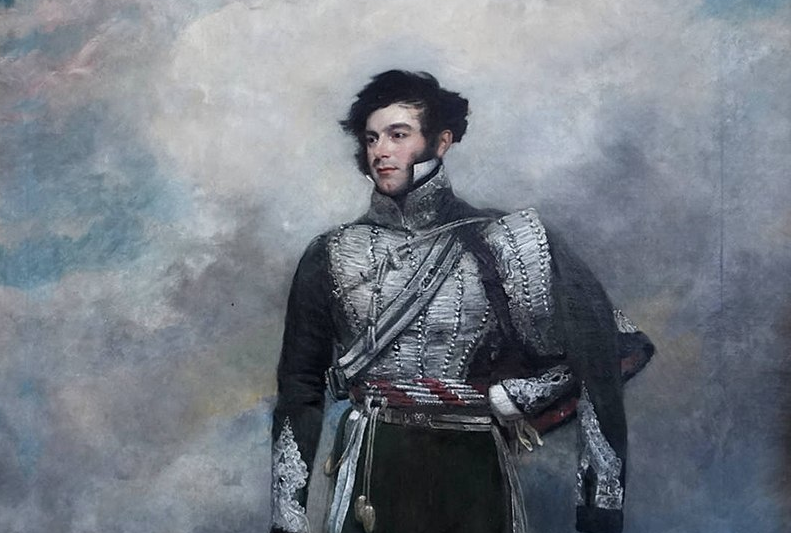
How does a sheep farmer from rural Warwickshire end up connected to one of the most powerful aristocratic dynasties in Georgian Britain? A faded land tax record in Burton Dassett should, in theory, have been a fairly ordinary piece of local history. Instead, it led me into a story about power, wealth, political ambition, and the rather fragile nature of aristocratic permanence.
The discovery
At first glance, it is a tiny archival detail: a faded land tax record listing tenants, payments, and proprietors in the Warwickshire village of Burton Dassett. Entirely routine local history, one might think. But sitting quietly in the occupier column was my 5 times great-grandfather, Francis Anderton. Beside him, in the proprietor column, sat the Marquess of Buckingham.
That record opened a door into aristocratic power, royal favour, Georgian politics, the American colonies, Ireland, Stowe House, one of the most spectacular financial collapses of nineteenth-century Britain and one of the most politically influential aristocratic dynasties of Georgian Britain: the Grenvilles and the Temples.
While Francis was tending sheep beneath the Warwickshire hills during the Regency era, the family collecting rent from the same land were advising kings, governing Ireland, entertaining royalty, and helping shape imperial politics on both sides of the Atlantic. And that immediately made me wonder something. How often do we imagine history flowing only from the top down?
Here, in a simple local tax record, were two lives connected directly through land, labour, and money. One family projected permanence through titles and power. The other worked the land that sustained it all.
Burton Dassett
Francis Anderton was born in 1774 in Burton Dassett, a south Warwickshire parish shaped by agriculture, grazing land, and the steady rhythms of rural life. The hills surrounding the village were well suited to sheep farming, and by the late eighteenth century Francis appears within that agricultural economy as a tenant occupier farming land connected to the Marquess of Buckingham’s wider estates.


At the time, Burton Dassett may have seemed far removed from the centres of political power, but villages like this formed the economic foundation of aristocratic Britain. Great families such as the Grenvilles and Temples depended heavily upon agricultural rents flowing steadily inward from estates scattered across counties including Warwickshire.
The wealth sustaining grand houses, political careers, and royal influence ultimately began in places very much like Burton Dassett, with tenant farmers working the land beneath them.
How many ordinary farming families realised their rents and labour fed into political worlds so vastly removed from their own daily lives? And equally, how many aristocrats ever truly considered the people quietly sustaining their fortunes beneath them?
The Buckinghams1 were not merely wealthy landowners. Georgian Britain was full of wealthy landowners. The Grenville-Temple family occupied an altogether more elevated level of influence, sitting close to the centre of British political life throughout the eighteenth and early nineteenth centuries.
Even the name itself gives the game away. George Nugent-Temple-Grenville (1753-1813), 1st Marquess of Buckingham, sounds less like one man and more like several ambitious aristocratic dynasties stitched together through inheritance, marriage, and an aggressive determination not to let a profitable surname disappear. Which is, in essence, precisely what happened.

The Grenvilles rise
The story begins with the Temple family of Buckinghamshire. During the seventeenth century, the Temples established themselves as major landowners, with their seat at Stowe gradually developing into one of the grandest estates in England.
Under Richard Temple, Stowe became far more than a country house. Richard Temple, Lord Cobham, was a soldier, politician, and influential Whig statesman whose political circle became deeply embedded within Georgian public life. The estate itself evolved into a carefully staged performance of aristocratic confidence.
Stowe was expanded throughout the eighteenth century into a monumental display of classical architecture, landscaped gardens, ornamental lakes, triumphal arches, temples, statues, and carefully engineered vistas intended to communicate refinement, education, patriotism, and enormous wealth. Visitors travelled from across Europe to admire it. Politicians gathered there. Royalty visited. Nothing says “modest family home” quite like scattering classical temples across several hundred acres because one drawing room simply was not making a sufficiently dramatic statement.

The Grenville connection emerged through inheritance when Richard Grenville inherited the Temple estates through his mother, Hester Temple, sister of Lord Cobham, in 1749. In aristocratic Britain, inheritance was rarely straightforward. Estates, titles, influence, and surnames tended to merge together like highly ambitious corporate mergers conducted entirely through marriage settlements. Richard adopted the additional surname Temple, creating the Grenville-Temple dynasty that would dominate British political society for generations.
The American crisis
Before the Reform Acts of the nineteenth century, British politics operated heavily through landownership, patronage, and aristocratic influence. Large landowners controlled parliamentary seats, shaped county politics, influenced appointments, and maintained extraordinary social power. The Grenvilles embedded themselves deeply within this system, producing politicians, ministers, administrators, and power brokers across multiple generations.
Among the most important figures in the family was George Grenville, uncle of the future Marquess of Buckingham. Serving as Prime Minister between 1763 and 1765, George Grenville achieved the rather unfortunate distinction of helping to push Britain toward the American Revolution through the Stamp Act of 1765.

From the British government’s perspective, the logic initially seemed perfectly reasonable. Britain had emerged victorious from the Seven Years’ War but financially exhausted, and maintaining troops in North America was expensive. Grenville’s government therefore concluded that the American colonies ought to contribute more directly toward imperial defence through taxation. The colonies responded with the political equivalent of “absolutely not.”
The Stamp Act imposed taxes on newspapers, legal documents, licences, pamphlets, and printed materials throughout the colonies. Colonial leaders objected not merely to the tax itself, but to Parliament imposing taxation upon populations lacking direct representation. The resulting protests, boycotts, intimidation campaigns, and political resistance fundamentally altered relations between Britain and America. Although the Act was repealed in 1766, the constitutional crisis it created became one of the major turning points leading toward revolution.

So while Francis Anderton was later farming sheep in rural Warwickshire, the family connected to the land beneath him had already helped shape events unfolding thousands of miles away. It is easy to think of Georgian political history as something distant from ordinary village life, but the Burton Dassett land records tell a different story. The same agricultural system sustaining Francis’s livelihood was also sustaining aristocratic political influence, imperial ambition, and the vast social world orbiting families like the Buckinghams.
That contrast feels central to understanding Regency Britain. Aristocratic power looked grand, permanent, and untouchable, but it rested upon ordinary rural labour. And perhaps this is the question sitting quietly underneath the entire story: whose lives actually held society together?
George III and the Buckinghams
By the time Francis was occupying land in Burton Dassett, the Grenville-Temple family sat near the summit of Georgian society.
George Nugent-Temple-Grenville (1753-1813) inherited not merely wealth but an expectation of political importance. Educated at Eton and Christ Church, Oxford, he entered Parliament in 1774 and steadily accumulated offices, influence, and royal favour. In 1779, he inherited Stowe following the death of his uncle, In 1784, George III elevated him to the title of Marquess of Buckingham, made him a Knight of the Garter in 1786, firmly cementing the family among the highest levels of British aristocracy.
The connection to George III mattered enormously. Georgian Britain functioned through overlapping networks of aristocratic loyalty, royal patronage, and political alliance. Families like the Grenvilles were useful to the Crown because they controlled influence, votes, and regional power. In return, royal favour strengthened their social and political standing further. Buckingham became part of the wider governing world surrounding George III during a period marked by imperial conflict, political instability, war with revolutionary France, and growing pressures for reform.
Buckingham later served twice as Lord Lieutenant of Ireland, governing during periods of profound unrest and political tension, including the years surrounding the Irish Rebellion of 1798 and the political manoeuvring that led toward the Act of Union in 1801. Ireland at the time was marked by religious division, economic inequality, and demands for parliamentary reform, making the role considerably more complex than simply attending banquets in excellent tailoring.
Meanwhile, the family’s enormous wealth continued to flow from estates scattered across counties including Warwickshire. This is where Burton Dassett becomes so important to the story because it grounds all this aristocratic grandeur back into the practical reality sustaining it. Stowe House, political influence, royal favour, Irish administration, parliamentary careers, ornamental temples, and aristocratic entertaining were all funded ultimately through land and agricultural rents.
The land tax records from Burton Dassett capture this contrast beautifully. In one column sits the Marquess of Buckingham as proprietor. Beside him sits Francis Anderton as occupier of the land itself. One man owned the estate. The other worked it. One was governing Ireland and entertaining political elites beneath painted ceilings. The other was tending sheep beneath Warwickshire rain clouds while trying to make a living from the land. Both men depending entirely upon the same agricultural economy.


The timing of Francis’s life makes the contrast even sharper because he lived through a period of enormous economic instability. During the Napoleonic Wars, agricultural prices rose significantly, benefiting many landowners and larger tenant farmers. But after 1815, prices collapsed across rural Britain. Agricultural depression followed. Wages stagnated, poor relief costs increased, and many tenant farmers faced growing insecurity. The Regency period may now survive largely through television adaptations involving meaningful eye contact across ballrooms, but much of rural England experienced it rather differently.
England on the brink of change
The agricultural economy that sustained aristocratic Britain became increasingly unstable after the Napoleonic Wars. Prices fell sharply after 1815, rural hardship increased, and many tenant farmers struggled beneath growing economic pressure. Francis Anderton’s life reflects these wider changes quietly but clearly. By 1831, he and his brother Thomas were recorded as qualified jurors in Burton Dassett, indicating respectable local standing linked to property occupation and taxation. Yet within only a few years Francis had left agricultural life behind altogether. By the late 1830s he was living near Birmingham, and by 1841 he appears in the census not as a sheep farmer but as a milkman.
I find that transition oddly moving. History often remembers the people at the top of society, but it is ordinary families adapting quietly to economic change who reveal how Britain itself transformed. How many similar lives disappeared into industrial towns without leaving behind much more than a census entry and a change of occupation?
Ironically, while Francis adapted to new economic realities, the Buckinghams continued spending as though the eighteenth century had no intention whatsoever of ending. George’s son, Richard Temple-Nugent-Brydges-Chandos-Grenville (1776-1839), inherited immense wealth, enormous prestige, and apparently no meaningful interest whatsoever in financial restraint. Created Duke of Buckingham and Chandos in 1822, he became notorious for extravagant spending on politics, architecture, entertaining, and estate maintenance. Unfortunately for the family fortunes, this tendency toward aristocratic excess was inherited quite enthusiastically by his son, Richard Plantagenet Temple-Nugent-Brydges-Chandos-Grenville (1797-1861), the 2nd Duke of Buckingham and Chandos, later known rather memorably as “the Debtor Duke.”

The decline of the Buckinghams
The 2nd Duke inherited not only the vast Stowe estate and its political legacy, but also a financial situation already teetering dangerously beneath generations of lavish spending. Rather than steadying the situation, he largely accelerated the decline. Educated at Eton and Christ Church, Oxford, he moved comfortably within the highest levels of Victorian aristocratic society and maintained the sort of lifestyle expected of one of Britain’s great landed magnates. The difficulty was that aristocratic magnificence had become ruinously expensive by the Victorian period. Agricultural incomes were weakening, political reforms were shifting influence away from the landed elite, and maintaining enormous country houses with vast staffs and endless entertaining obligations required staggering amounts of money. The Buckinghams, however, appear to have approached these realities with tremendous optimism and very little budgeting.
Was the collapse inevitable by that point? Or had generations of aristocratic certainty simply made adaptation impossible?
Stowe remained a centre of aristocratic entertaining, political gatherings, and grand display long after the finances required to sustain it had begun collapsing underneath the surface. The family continued living with extraordinary splendour while debt mounted relentlessly behind the scenes. By the 1840s the financial situation had become catastrophic, and the collapse was spectacularly public.
In 1848, the contents of Stowe House were sold in an auction lasting over forty days. Furniture, paintings, sculptures, books, tapestries, chandeliers, and generations of accumulated aristocratic grandeur were dispersed piece by piece beneath the auctioneer’s hammer. For Victorian Britain, the sale became one of the great public symbols of aristocratic decline: a family who had once advised kings, shaped imperial politics, and projected absolute permanence now dismantled publicly through debt.

What endured?
The more I researched this story, the more fascinated I became by the contrast sitting quietly inside that Burton Dassett land tax record.
The Grenville-Temple family built an entire world designed to project permanence. They accumulated titles, advised kings, governed Ireland, entertained royalty, and transformed Stowe House into a monumental statement of aristocratic confidence. Every landscaped vista, classical temple, and carefully arranged avenue communicated power, stability, and the assumption that families like theirs would always remain at the centre of British society.
And perhaps that is the most interesting question of all: did aristocratic Britain genuinely believe its world could never change? Because change arrived anyway.
Within only a few generations, much of that grandeur collapsed beneath debt, political reform, and shifting economic realities. The family that once projected permanence across entire landscapes eventually saw its possessions dispersed piece by piece beneath the auctioneer’s hammer.
Francis Anderton left behind none of those things. No portraits in gilt frames. No ornamental lakes. No classical statues gazing thoughtfully across landscaped gardens. What survives of his life is quieter: parish entries, tax records, census returns, and evidence of a man adapting to a changing world. Yet there is something deeply compelling about that quietness.
Francis survived agricultural depression. He moved with the changing economy. He left rural farming behind when circumstances demanded it and rebuilt his life elsewhere. While aristocratic families often assumed the world would continue arranging itself around them, ordinary families rarely had that luxury. They adapted or struggled.
And I find myself wondering: which story ultimately proved more resilient?
History tends to focus naturally on the powerful. But Britain itself was built just as much by families like my ancestors, the Andertons. Perhaps we sometimes look at history from entirely the wrong direction. Are the famous names really the centre of the story, or are the quieter lives surrounding them where the real history actually sits?
There is also something surprisingly modern about all this. We still live in a culture fascinated by wealth, status, influence, and carefully constructed images of success. Grand country houses may have become penthouses, tech empires, celebrity brands, or billionaire lifestyles, but the performance of permanence remains remarkably familiar. Wealth still projects confidence. Power still tries to look untouchable.
If there is a lesson hidden inside that faded Burton Dassett land tax record, perhaps it is this: power often looks permanent in the moment, but resilience usually belongs to the people who learn how to survive change.
And honestly, I suspect history still underestimates those people far too often.
- British aristocratic families often took the name of their estates instead of their family names, which can be a little confusing. For example, when George Nugent-Temple-Grenville was made a Marquess, he then went by the name of Buckingham. ↩︎




Leave a Reply