
A couple of weeks ago, I wrote about my plans to take the family on a genealogy road trip. My husband had a week off work, the children were still on their summer holidays, and rather than disappearing on my own to investigate dead relatives, I decided it would be much more sociable to take everybody with me. There were, admittedly, incentives involved. The children were promised activities considerably more exciting than graveyards and old villages, while my husband was offered the opportunity to spend quality time with his family. I still maintain that this was a perfectly reasonable arrangement.
The plan was to revisit two ancestors who have already appeared on Regency Relatives. The first was King Charles, whose family lived around Frampton-on-Severn in Gloucestershire. The second was Francis Anderton, who lived and farmed around the Burton Dassett Hills in Warwickshire. I had already researched and written about both men, so this wasn’t intended to be a particularly serious research trip. I wanted to see the places that had become familiar through records, get a better sense of the landscape in which they lived and, ideally, find a few physical traces of them along the way.
As it turned out, the trip was considerably more productive than I expected. We found places I had previously only seen named in records, visited churches connected with the families, wandered around churchyards looking for familiar surnames and got a much better sense of how the different locations fitted together. I also came home with new information about both King and Francis, which means that two ancestors whose stories I had regarded as reasonably complete are now back on the research list.
And yes, there were sheep.
Following the Charles family through Gloucestershire
Our first proper genealogy day took us into Gloucestershire and the area around Frampton-on-Severn, where generations of the Charles family had lived. I had several places I wanted to visit, but this wasn’t about racing from one location to another simply to take photographs and say I had been there. What I really wanted was to understand how the places I had encountered during my research related to one another. Looking at them on a modern map is useful, but driving between them and seeing the landscape gives you a much better appreciation of the relatively small world in which many of our ancestors lived.


One of those places was Muddleshole, where King Charles lived and which survives today in the area around the junction of Bath Road and Middle Street. We also travelled through Whitminster, Eastington and the surrounding villages, following roads and place names that had appeared during my research. Some names have changed over time, while other locations were surprisingly easy to recognise. There was something particularly useful about seeing just how close these communities were to one another. When the same collection of villages repeatedly appears in baptisms, marriages, censuses and other records, it is easy to treat each place as a separate piece of information. On the ground, the relationships between them make considerably more sense.
There were also some reminders that places continue to have lives long after our ancestors have left them. Buildings remain while their purposes change, roads acquire slightly different names and settlements expand into spaces that would have been open countryside. The Whitminster Inn, for example, is still standing, although anyone hoping to recreate the nineteenth-century drinking experience may be surprised to discover that it is now an Indian restaurant. We stopped for lunch at a pub in Eastington which would have been familiar as a building during King’s lifetime, although whether King himself ever went through the door is something I have absolutely no evidence for and therefore will not be adding to the family history simply because it would make a nice story.
That distinction between what could have happened and what we can actually demonstrate is important. Visiting a place gives us context, but it doesn’t create evidence. I can now picture the roads King might have travelled and understand the distances between places associated with his life, but I cannot turn geographical possibility into historical fact. What the visit did do was make me look again at some of the evidence I already had, and that subsequently led me in directions I had not anticipated before the trip.
Frampton-on-Severn
Frampton itself was one of the places I particularly wanted to see. The village green and surrounding landscape gave me a much better impression of the community in which the Charles family lived, but the main destination was St Mary’s Church. King married Hester Grafton there, and he was later buried in the churchyard, so I was hoping there might still be a Charles gravestone to find.
I knew before we arrived that finding King’s grave was far from guaranteed. A burial record tells us where somebody was buried, but it doesn’t follow that there was ever a permanent headstone, and even when there was, nearly two centuries of weather, damage and changes to a churchyard can easily remove the evidence. We searched anyway, because knowing that something is unlikely has never been a particularly effective deterrent in genealogy.


There are many old stones at St Mary’s, but a significant number are now so weathered that their inscriptions are difficult or impossible to read. We didn’t find a surviving stone that I could identify as King’s. I did manage to speak briefly to the church verger, who explained that the church doesn’t have a grave plan that would allow us to identify his precise burial location. Our conversation was necessarily short because he was preparing for a funeral, which seemed a fairly compelling reason not to keep him talking about somebody who had been buried there in 1870.
What we did find was a Charles gravestone. The name on it was Reuben Charles, and for a brief and exciting moment I thought I knew exactly who he was. There was already a Reuben in my Charles research, and finding a physical memorial to a member of the family would have been a rather satisfying result from the visit. Unfortunately, there was a problem. The dates were wrong.
Not slightly wrong in the way that ages occasionally wander around nineteenth-century records. Wrong enough that this clearly wasn’t the Reuben I had expected him to be.
So I took photographs.

Once I was home, I did what any sensible genealogist would do after finding the gravestone of somebody who apparently had nothing to do with the research I was conducting. I started researching him.
This Reuben Charles was baptised at Frampton-on-Severn in 1818 and recorded as the base-born son of Elizabeth Charles, a servant. That immediately caught my attention because I already have an Elizabeth Charles in my family tree, born in Frampton in 1796. An Elizabeth of that age could certainly have been Reuben’s mother, and the combination of surname, place and chronology makes the possibility worth investigating. It does not, however, make her his mother.
At the moment, Reuben sits firmly in the category of interesting people who may or may not turn out to belong to my family. I have been looking for evidence that could either connect his mother to my Elizabeth or demonstrate that they were two different women. So far, the question remains open. Reuben himself, meanwhile, appears to have lived his life around Frampton, married twice in the parish and managed to make several appearances in the newspapers. He has therefore become a research project in his own right despite not being on the itinerary when we left home that morning.
This is one of the reasons I record things that don’t immediately fit. It would have been very easy to walk past the stone once I realised the dates didn’t match the Reuben I already knew about. Instead, one photograph has created a completely new line of enquiry. Whether it eventually connects back to my Charles family is almost secondary. At the very least, trying to establish who his mother was is a useful exercise in distinguishing between a plausible identification and one that can actually be supported by evidence.
From Gloucestershire to Warwickshire
The second part of the road trip took us north to Warwickshire and the Burton Dassett Hills, an area associated with another ancestor I have previously written about, Francis Anderton. Francis’s story is very different from King’s, and my reason for visiting was different too. Here, my primary objective was seeing the landscape.


Francis was a farmer, and the records tell us about land, livestock and the practical business of rural life. Those descriptions become considerably easier to understand when you can see the terrain for yourself. The Burton Dassett Hills give wide views across the surrounding countryside, and standing there made it much easier to appreciate the physical setting of the farms and communities that appear in the documentary record. This wasn’t a revelation that suddenly changed Francis’s identity, but it added something that no census entry or parish register really can.
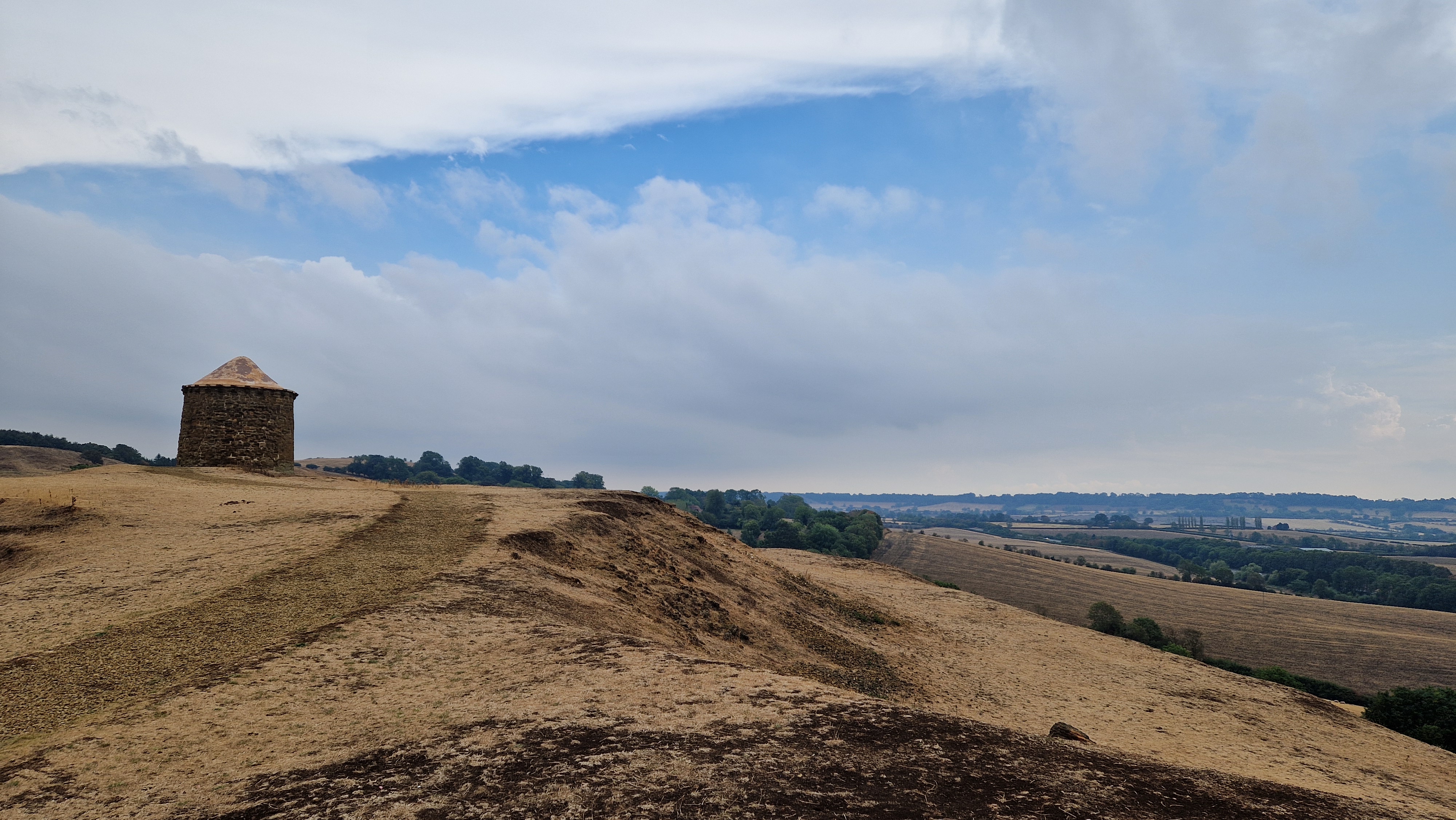
There was also something strangely satisfying about finally standing beside the Beacon Tower on the Burton Dassett Hills. I have seen it countless times from the M40, without ever giving it much thought. I certainly hadn’t realised that, somewhere in the landscape around that familiar landmark, my ancestor Francis Anderton had once farmed sheep.
At All Saints’ Church in Burton Dassett, I was particularly keen to look for surviving Anderton graves. Five members of Francis’s family died within the space of just six weeks, and Ancestry hints suggested that I should be able to find at least one family headstone. Armed with that rather optimistic expectation, we set about searching the churchyard.
It wasn’t the easiest place to investigate. The churchyard sits on a surprisingly steep slope, with several headstones leaning or already succumbing to gravity, while the prolonged dry weather had left deep cracks and the occasional hole in the ground. This meant trying to read weathered inscriptions while also paying rather more attention than usual to where I was putting my feet.


Unfortunately, despite a thorough search, there wasn’t an Anderton headstone to be found. Whether the memorial I was expecting has been lost, become illegible, fallen, or simply defeated my search remains unclear. It was mildly disappointing, particularly after Ancestry had given me reason to expect otherwise, but also a useful reminder that a record of a grave or memorial online doesn’t necessarily mean there will still be something identifiable when you get there.
Fortunately, this was also the part of the trip where the genealogy-to-child-entertainment exchange scheme came into effect, and we went on to Warwick Castle. I therefore consider the agreement honoured. My husband may have a different interpretation of events, but he has not been invited to contribute to this article.
Two ancestors I thought I already knew
The most useful outcome of the road trip wasn’t finding a particular gravestone or standing in a particular place. It was what happened when I came home.
Both King Charles and Francis Anderton had already been researched sufficiently for me to write about them on Regency Relatives. Their stories weren’t completely finished, because family history rarely is, but neither man was sitting prominently on my research list. I had other ancestors, other questions and more than enough unfinished investigations to occupy me. Visiting the places associated with them changed that. It made me return to records I had already seen, search for material I hadn’t previously considered and look more closely at some of the local context. In both cases, I found more.
I’m deliberately not including those discoveries here because they deserve more than a paragraph at the end of a road-trip article. Instead, I’m going to revisit both of the original stories separately, looking at what I knew when I first wrote about these men, what I’ve discovered since, and whether any of it changes the picture I had previously built of their lives.
That, for me, has probably been the most useful lesson from the whole exercise. Publishing an ancestor’s story doesn’t mean the research is finished. Neither does reaching a point where you feel that you know them reasonably well. New sources appear, research skills improve and sometimes simply approaching an existing collection of evidence from a different direction produces something you didn’t see the first time.
The genealogy road trip therefore achieved rather more than I expected. I found the places I went looking for, failed to find the grave I hoped to find, accidentally acquired a completely different Reuben Charles and reopened two supposedly completed pieces of research.
The children got their promised treats, there were plenty of sheep, and my husband got a week’s holiday with his family. I really don’t know what any of them could possibly complain about.




Leave a Reply