
There are few moments in family history research more dangerous than the point at which a collection of mildly interesting parish records suddenly begins to resemble a fully formed Georgian domestic scandal, complete with suspiciously timed marriages, maritime connections, an exciseman wandering around southern England, and a woman called Honor who refuses to behave conveniently in the records.
This particular descent into genealogical instability began with my 4th great grandmother, Elizabeth Harris, who was baptised on 23 January 1786 in Wymering, Hampshire, just outside Portsmouth. The baptism entry itself appears deceptively straightforward, naming her parents as John and Honor Harris, which initially suggested the sort of ordinary Georgian family arrangement one hopes for when beginning a new line of research. Naturally, this illusion survived for approximately twelve minutes before the entire thing started unravelling spectacularly.
The first indication that something was not quite right came when I attempted to locate a corresponding marriage between a John Harris and an Honor anywhere in the surrounding Hampshire area within a sensible timeframe. Ordinarily, one would expect at least a moderately cooperative parish register to emerge eventually from the chaos, but despite extensive searching, no convincing marriage appeared. There were a handful of possibilities involving various Johns and various Honors, most of whom were very clearly not my people, but nothing that comfortably explained Elizabeth’s baptism in Wymering.
Now, under normal circumstances, this is precisely the point at which a sensible genealogist would calmly note the uncertainty, move on to another branch of the family, and perhaps enjoy a peaceful evening doing literally anything else. Unfortunately, I am apparently not that sort of genealogist.
Instead, I went rogue, and started to research all the Honors who married Johns in England since the beginning of time (well, the beginning of record keeping, anyway). This kept me busy for a few evenings, before I discovered a marriage dated 1799 in Wroughton between a John Hardwicke and an Honor Harris. Now, “Honor” is not an especially common name in Georgian parish registers, which immediately made the record suspiciously interesting.
Matters became considerably more compelling when I discovered that the marriage had taken place by licence and that the Sarum marriage licence bonds described John Hardwicke as both a widower of the parish of Swindon and an exciseman.
At this point, I stopped casually researching and began behaving like a deeply unstable Regency detective with an increasingly unhealthy emotional attachment to Wiltshire marriage records.

Excisemen, for anyone fortunate enough not to have spent several evenings reading about eighteenth-century taxation systems for pleasure, were government officers responsible for collecting duties on taxable goods, particularly alcohol and imported commodities. Unlike agricultural labourers who frequently remained rooted in the same villages for generations, excisemen were mobile Crown employees who moved between market towns, ports, customs districts, and administrative postings as required.
Suddenly, therefore, the Hampshire connection ceased to look entirely random. Portsmouth and the surrounding area would have represented an important excise environment during the late eighteenth century, particularly during the wider context of wartime expansion and maritime activity associated with the Napoleonic Wars.
The licence bond itself became even more interesting when it named the bondsman as Richard Noad, innkeeper of Swindon. This, socially speaking, makes excellent sense. Innkeepers and excisemen occupied closely connected worlds involving taxable alcohol, licensing systems, transport networks, and local commercial administration.
The entire thing began to develop the faint but unmistakable smell of plausibility. And so, inevitably, I developed a theory.
Perhaps Honor Harris of Wroughton had entered into a relationship with John Hardwicke of Swindon while he was still legally married to another woman. Perhaps Elizabeth, my 4th great grandmother, had been born during one of John’s excise postings in Hampshire while the couple were living together unofficially around Portsmouth. Perhaps they had been unable to marry legally until John’s first wife died (as divorce was not permitted during the Regency period).
Frankly, it all fitted together so elegantly that I should have recognised immediately that disaster was approaching.
Further research revealed that a John Hardwicke had married Mary Herring in Swindon in 1777, and that Mary Hardwick [sic.], wife of John Hardwick [sic.] was later buried in Calne in 1789. At this stage, the theory still held together reasonably well. If Mary had died in 1789, then perhaps John and Honor had finally been free to marry afterwards.
Unfortunately, this fragile moment of optimism lasted only until I discovered yet another marriage for a John Hardwicke, this time to Phoebe Ettry. Phoebe then died in 1798.
If all of these records refer to the same man, John Hardwicke did not marry Honor immediately after the death of Mary at all. Instead, he appears to have married Phoebe first, become widowed for a second time, and only then married Honor Harris in 1799.
This was, academically speaking, not ideal. Because if John and Honor had already produced Elizabeth together in 1786, why on earth would he marry another woman after becoming free to marry?
There are, admittedly, possible explanations. Georgian domestic life was often considerably messier than parish registers politely suggest. Practical remarriages, unstable relationships, financial necessity, social respectability, and long unofficial partnerships all coexisted quite comfortably beneath the carefully ordered surface of eighteenth-century parish life.
Nonetheless, the Phoebe marriage introduces genuine uncertainty into what had previously been an extremely satisfying theory. Consequently, I am now left balancing two competing possibilities concerning the parentage of my 4th great grandmother.
The first is that John Hardwicke genuinely was Elizabeth’s father and that he and Honor Harris maintained some form of complicated, long-running, irregular relationship over many years before eventually marrying legally in 1799 following the death of his second wife.
The second possibility is that Elizabeth’s father was another John entirely and that Honor Harris later married widower John Hardwicke independently, thereby creating a completely misleading but deeply compelling collection of overlapping records designed specifically to ruin my evenings. At present, frustratingly, I cannot conclusively prove either interpretation.
What continues to draw me back toward the first theory, however, is Portsmouth itself, because Portsmouth refuses to disappear from this family story no matter how hard I attempt to behave rationally about it.
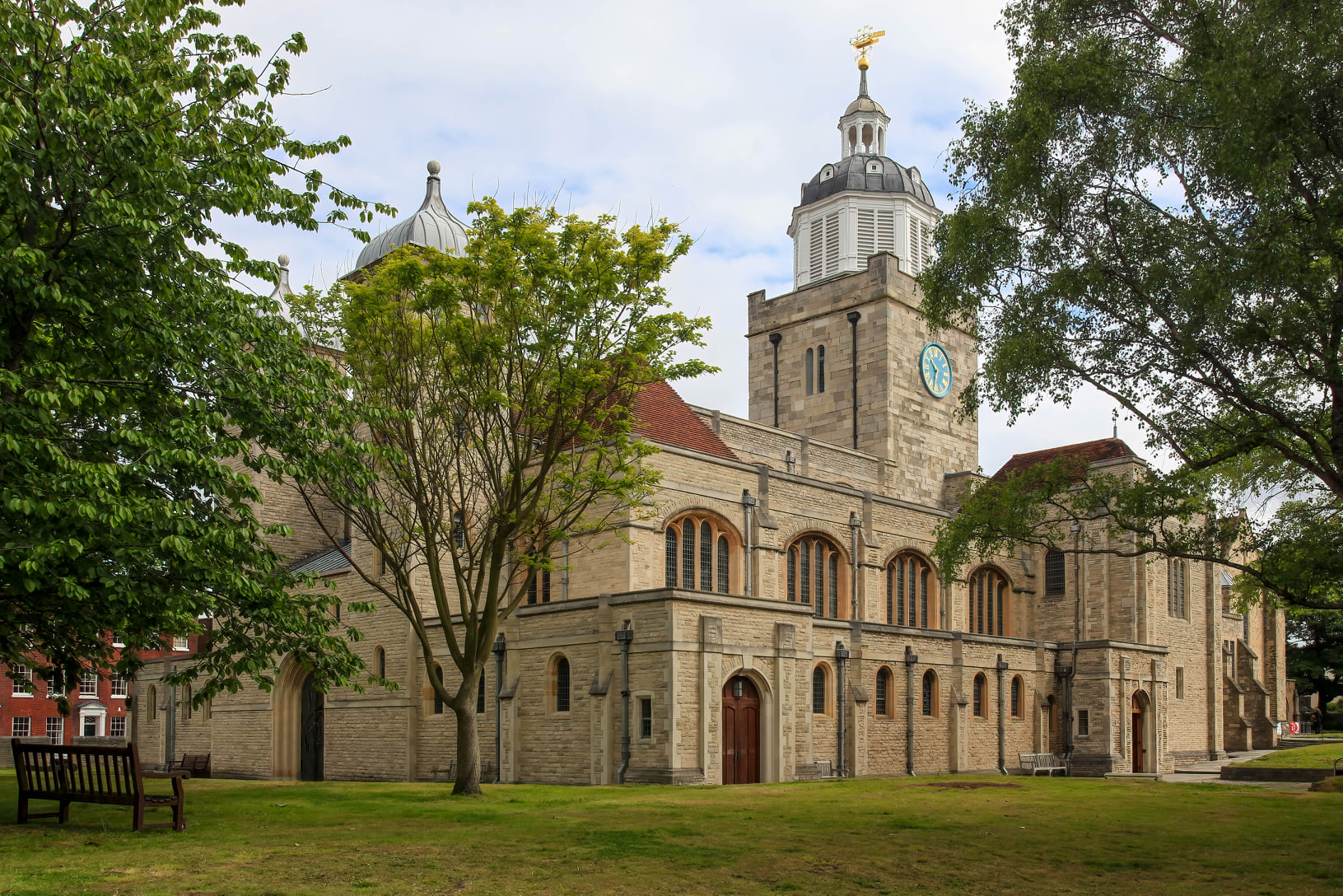
On 18 July 1809, Elizabeth Harris married John Felton at St Thomas of Canterbury Church in Portsmouth, now known as Portsmouth Cathedral. John Felton served in the Royal Marines during the Napoleonic Wars, a period during which the Marines expanded dramatically in both size and operational importance.


By 1809, Britain was deeply engaged in the wider Napoleonic conflict, and Royal Marines served not only aboard naval vessels but also as elite landing troops during campaigns including Walcheren, Corunna, and operations extending into the Persian Gulf.
Elizabeth and John later settled in Solihull, where they produced what can only be described as a truly formidable quantity of children, including my direct ancestor Henry Felton, born there in 1822.
Yet Portsmouth still stubbornly clings to the family narrative because Elizabeth’s son, John William Felton, was reportedly born at sea in Portsmouth Harbour in 1812, which rather strongly suggests that the family’s maritime connections were not incidental.
And this is the point at which the entire thing became genuinely unsettling. Because I was born in Birmingham in 1978. Then, entirely independently and with absolutely no knowledge whatsoever of any of this family history, I moved to Portsmouth in 1997 and eventually settled in Portchester. Which is only a few miles from Wymering.
So after spending considerable time researching this family completely unaware of the connection, I eventually discovered that my 4th great grandmother had been baptised practically on my own doorstep more than two centuries earlier. Honestly, family history occasionally begins to feel less like historical research and more like being quietly stalked by one’s ancestors.
I haven’t yet given up hope of cracking this case. I have created one big spreadsheet (those that know me know how much I love a spreadsheet!) to try to follow the journeys of all the Johns in this branch of the family, hoping to piece together whether my initial suspicions (hopes?) are right and this is indeed a glorious Regency family scandal.
One final discovery did at least provide some accidental comic relief.
Every attempt to search for “John Felton Portsmouth”, to try to uncover a marriage certificate naming John Hardwicke as Elizabeth’s father, repeatedly produced not my ancestor, but Lieutenant John Felton, the man who assassinated George Villiers, 1st Duke of Buckingham, at the Greyhound Inn in Portsmouth in 1628 before being hanged at Tyburn.

Sadly, this appears to be an entirely different John Felton. Although, admittedly, a considerably easier man to research.





Leave a Reply