An Adventure at The National Archives
This week I made my first visit to The National Archives at Kew. My mission was straightforward enough. I wanted to find out when my ancestor John Hardwicke joined the Excise, where he was posted, and when he eventually left the role. Like most family historians, I began the project with a neat list of questions and a reasonable degree of confidence. By the end of the day, I had acquired several new questions, a booking for another visit, and a healthy respect for just how easily one can become distracted by eighteenth-century paperwork.
A few weeks before my visit, I created an account on the National Archives website and registered for a temporary reader’s ticket. This involved watching a video explaining how historical documents should be handled. At the time, I assumed this was simply a formality. As events later demonstrated, it was in fact useful information that I should probably have paid closer attention to. Once registered, I searched the catalogue and ordered twelve documents, which is the maximum allowed for a standard visit. I selected six Excise minute books and six pension rolls, estimating that John might have entered the service around 1781. Since I had no idea exactly when he appeared in the records, I ordered volumes covering approximately eighteen months either side of my best guess and hoped for the best. This, I have discovered, is an entirely legitimate research strategy when the alternative is ordering every volume produced by the British government between 1780 and 1790.
The National Archives are located at Kew, and my journey began with a train to Waterloo (which I almost missed), which arrived a modest thirty minutes late. From there I took the Northern Line to Embankment and changed onto the District Line. At this point, Google Maps informed me that I should leave the train at Gunnersbury. Foolishly trusting modern technology over the station name that was literally printed on my Archives booking confirmation, I obeyed. Within minutes I realised my mistake and boarded the next train for the thrilling one-stop journey to Kew Gardens. Things improved briefly when I emerged from the station and spotted a sign pointing towards The National Archives. Feeling reassured, I set off in the indicated direction. After six minutes of walking I decided to check Google Maps, as I have a habit of misnavigating around London, only to discover that of course I had somehow managed to walk in entirely the wrong direction despite the signs. Having retraced my steps, I eventually found the correct route and arrived around two hours later than planned.
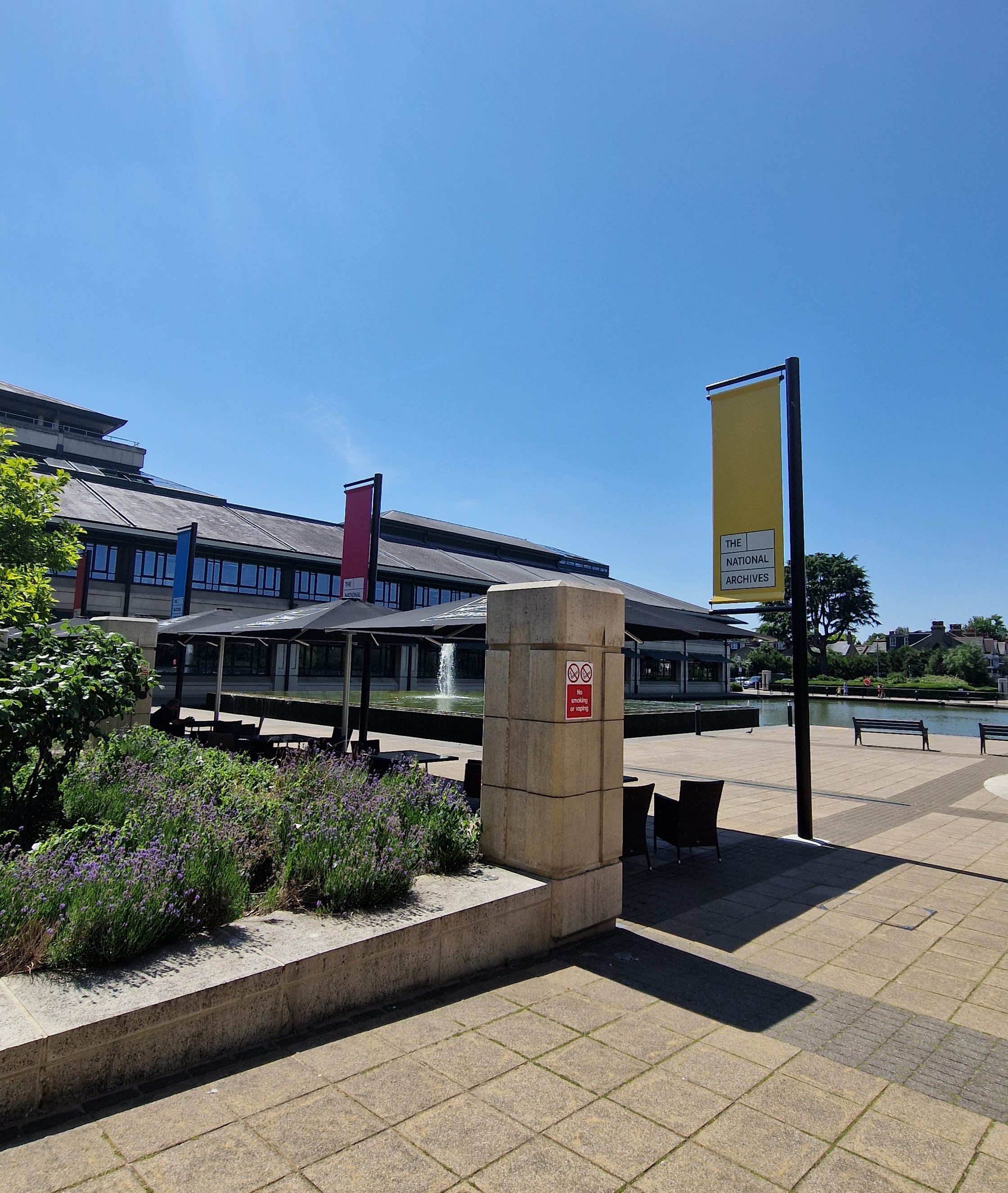
The walk from Kew Gardens station is actually rather pleasant when undertaken in the correct direction. A quiet residential road leads towards the archive grounds, and as you approach the site the scenery opens out unexpectedly. There are landscaped gardens, a large water feature and plenty of greenery surrounding an impressive Brutalist building.


Inside, visitors pass through security before entering a large atrium with a café, gift shop and seating area. Nearby hangs an enormous portrait of George III, who appeared considerably less flustered than the rest of us despite the fact that London was experiencing one of the hottest days of the year. Having skipped breakfast and spent the morning navigating delayed trains and unnecessary walks around south-west London, I decided that historical research could wait while I acquired a sandwich and a cold drink. Family history is important, but so is not fainting into an excise minutes book.

One piece of practical advice I would offer to first-time visitors is to use the lockers immediately. The cloakroom area contains lockers operated by a code system, and visitors are provided with a clear plastic bag for any items they wish to take into the reading rooms. I spent several minutes watching other people who clearly knew what they were doing while attempting to reorganise my belongings into an acceptable configuration.
My next task was to collect my reader’s ticket from the first floor. For this, you need two forms of identification: one photographic ID and one document showing your name and address. A photograph is taken and you are then issued with a card which serves as your identification, valid for three years. The card grants access to the reading rooms, allows you to log into archive computers, and enables you to order documents and check their retrieval status. By this stage I was beginning to feel like a very minor government official.
The reading room itself is remarkably quiet. On arrival, I was given a slip of paper with my desk number (27B) and informed that my pre-ordered documents were waiting in a locker corresponding to that desk. Feeling pleased with my efficiency, I collected several volumes and confidently sat down. Unfortunately, I had sat at somebody else’s desk. Having relocated to the correct seat, I began organising my notes before being informed that some of my stationery was not permitted. Specifically, a sheet of children’s stickers that had somehow found its way into my notebook and a pencil fitted with an eraser. The stickers, I am pleased to report, were not part of an elaborate plan to decorate eighteenth-century government records. Nevertheless, both items were confiscated. Fortunately, pots of approved pencils are provided throughout the room.

Eventually I opened my first volume and began reading. A member of staff soon appeared again and gently reminded me that I should be using the foam supports and weighted snakes demonstrated in the training video. This was awkward, because I had already forgotten most of the training video. Having retrieved the appropriate equipment, I settled down to work and quickly encountered a second problem. I could no longer remember what the document actually was. After consulting the catalogue description online, I reminded myself why I had ordered it and discovered that the first pages consisted largely of an index. A volume that had initially appeared to contain nothing of interest suddenly made much more sense.
Over the next few hours I worked through all six of the Excise minute books I had ordered. I found no reference whatsoever to John Hardwicke. This is a familiar experience for anyone involved in family history research. We tend to talk enthusiastically about discoveries while spending rather less time discussing the many hours devoted to proving that an ancestor is not in a particular record set. Fortunately, the staff at Kew are exceptionally knowledgeable. After explaining what I was looking for, they directed me to a digitised name index that covered the records I was using, which is also accessible online… from home… Armed with this information, I spent some time working systematically through indexes from 1781 to 1789, like I should have done before taking volume pot luck. There were four books per year and, naturally, the entries I needed appeared in the final volumes I checked.
Having finally located references to both a John Hardwicke and a John Hardwick, I returned the documents I had already examined and ordered one of the newly identified volumes. Retrieval takes time, so I returned to the café for coffee before wandering around the grounds. At one point I found myself sitting beneath a parasol watching a goose shepherd a collection of goslings around the pond. Ninety minutes later, I suddenly remembered that I had travelled to London to research an ancestor rather than conduct an observational study of waterfowl and hurried back upstairs.


This time the effort paid off. Waiting in the locker was a volume containing entries for John Hardwick. Finally, after an entire day of searching, I had found the name I was looking for. The problem was that the entry placed him in Sussex rather than Hampshire or Wiltshire, where I had expected him to be. Instead of answering my question, the record introduced a new one. Was this my John Hardwicke recorded under a slightly different spelling (as for one of his marriage records), or had I discovered an entirely different exciseman? While pondering this dilemma, I also noticed another individual in the records who happened to share my surname. Like any sensible family historian, I immediately became distracted by the possibility of being related to him before remembering that I was supposed to be researching somebody else.


Having photographed the relevant pages, I returned to the computer to order the remaining two volumes. The clock displayed 15:31. The final document ordering time had been 15:30. I stared at the screen for a moment, sighed, and accepted that the remaining records would have to wait for another day. Within minutes I had booked a return visit for 9 July.
Did I find the answers I was looking for? Not entirely. Did I leave with a better understanding of the records, several new leads, and a renewed determination to continue the search? Absolutely.
After collecting my belongings, I walked over to Kew Gardens, where reduced admission after 4pm makes it an excellent companion to a day at the archives.


The gardens were beautiful, the weather was glorious, and for a few hours I exchanged eighteenth-century excisemen for flowers and trees. John Hardwicke remains stubbornly elusive, but the next chapter of the investigation is already booked.