
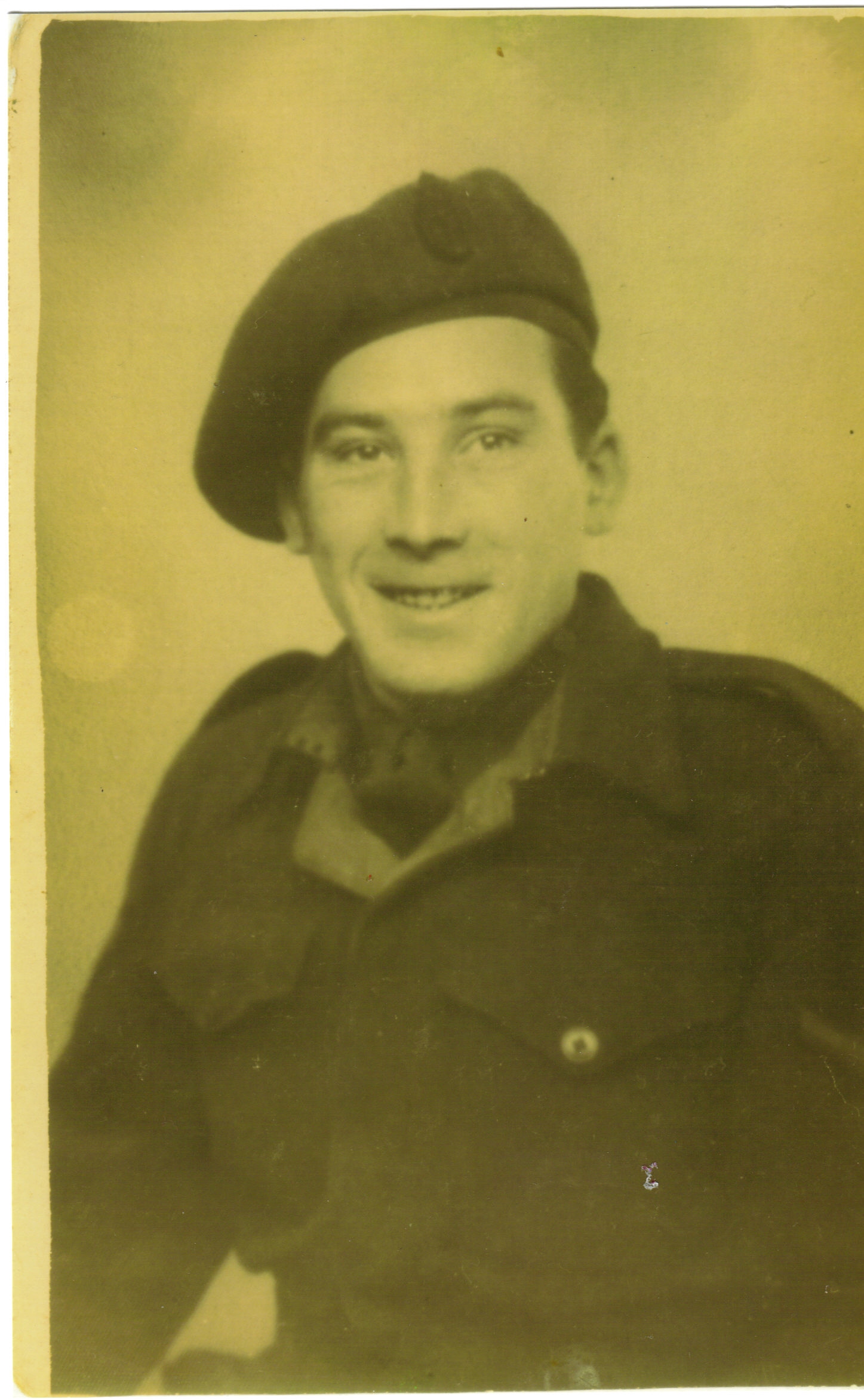
One of the things I love most about family history is discovering that people you thought you knew, or at least knew something about, turn out to have lived rather more interesting lives than anyone bothered to mention.
Take my grandad, Leslie Edgar Martin. I knew he’d been in the Army during the Second World War, but that was about the extent of it. Like many men of his generation, he wasn’t particularly forthcoming about his wartime experiences, and I don’t remember them being a regular topic of family conversation. As for his father, my great-grandfather Francis Bertie Martin, I knew very little about him at all.
It turns out that between them, father and son served through two world wars. Francis joined the Royal Naval Volunteer Reserve in 1917, while Leslie spent almost seven years in the Army during and immediately after the Second World War. Both came home, both returned to fairly ordinary working lives, and neither appears to have left much of an account of what they got up to.
Fortunately, the military authorities were rather more enthusiastic about paperwork. Over the past few months, I’ve been piecing together their stories from service records, medal entitlements, census returns, electoral registers and the occasional newspaper report.
Francis Bertie Martin 1898-1987: A Collier Joins the Navy
Francis Bertie (Frank) Martin was born in Pontypridd on 5 April 1898, into a family with strong connections to the South Wales coalfields. His father, Benjamin Thomas Martin, had worked as a haulier before moving into colliery work, and the family had lived in several of the mining communities of Monmouthshire and Glamorgan. By the time Francis was old enough to earn his own living, he was working as a collier too. It was hard, dangerous work, although perhaps not the worst preparation for the physical demands of military life.
When the First World War broke out in August 1914, Frank was just sixteen. Three years later, on 22 October 1917, he joined the Royal Naval Volunteer Reserve, aged nineteen. I’ve not yet established whether he volunteered enthusiastically, was encouraged to join or simply found himself caught up in the enormous demand for military manpower. What I do know is that he exchanged his life in the Welsh coalfields for the rather different world of the Royal Navy.
The Royal Naval Volunteer Reserve, or RNVR, had originally been established to provide volunteers who could supplement the regular Navy when needed. During the First World War, its men undertook all sorts of duties, both aboard ships and at shore establishments. Frank’s service record gives us a surprisingly detailed description of the young man who signed up. He was five feet seven and a half inches tall, with light brown hair, hazel eyes and a chest measuring thirty-five and a half inches. I rather like finding these little details. Birth certificates and census returns are all very useful, but they don’t tell you what someone actually looked like. A century later, it’s quite nice to be able to picture Francis as something more than a name on a family tree.
Frank’s service record lists several establishments, including HMS Victory II, HMS Victory I, HMS Excellent and HMS President III, and he progressed from Ordinary Seaman to Able Seaman during his service. Now, if you’re imagining my great-grandfather sailing around on Nelson’s flagship, I’m afraid I have to disappoint you. The Royal Navy had a habit of giving shore establishments the names of ships, which makes researching naval ancestors slightly more confusing than it needs to be. HMS Victory I was associated with Portsmouth, while HMS Victory II was connected with the naval training establishment at Crystal Palace in London.

Source: RNVR Service Records Index, The National Archives, Kew.
HMS Excellent was the Royal Navy’s gunnery establishment at Whale Island in Portsmouth, which is particularly interesting to me, having lived in the Portsmouth area for nearly thirty years. It’s rather strange to think that my great-grandfather was connected with places I’ve passed countless times without ever knowing he had been there. HMS Excellent is perhaps the most intriguing entry. As a gunnery establishment, it was responsible for training naval personnel in the use of weapons and related skills. Whether Francis actually trained as a gunner is another matter. His record tells me he was attached to the establishment, but it doesn’t tell me precisely what he was doing there.
Towards the end of his naval service, Frank was attached to HMS President III, a shore-based administrative establishment involved in the enormous task of demobilising naval personnel following the end of the First World War. Although the Armistice was signed in November 1918, thousands of sailors remained in service while the Royal Navy worked through the complicated business of returning men to civilian life. HMS President III played a role in processing their accounts and demobilisation paperwork, ensuring that the necessary administrative arrangements were completed before they could finally go home. Frank was involved in this work, helping other servicemen make their way back to civilian life while awaiting his own discharge. He was eventually demobilised on 13 May 1919, six months after the Armistice.
When Frank returned to civilian life, he married Lillian Maud Hillman and eventually settled in Birmingham. By 1939, he was working as a rubber tyre moulder, having apparently left the coal industry behind. Frank was forty-one years old, married, working and raising a family. He had already lived through one world war, and now another had begun. This time, it would be his son who went into uniform.
Leslie Edgar Martin 1920-2007: From Birmingham to the Battlefields of Europe and beyond
My grandad, Leslie Edgar Martin, was born in Blackwood, Monmouthshire, on 30 December 1920, just over two years after the end of the First World War. He grew up in a world that was still dealing with the consequences of that conflict, although I have no idea whether Frank shared much of own wartime experiences with his son.
On 28 April 1939, Leslie enlisted in the Territorial Army in Birmingham. He was just eighteen years old, Britain was still at peace, and the outbreak of the Second World War was only four months away. According to family legend, his main motivation for joining was to acquire a decent pair of boots. Whether that was the entire reason is something I’ll probably never know, but what began as a relatively ordinary decision would lead to more than seven years of military service.

Leslie’s attestation papers provide a rather lovely glimpse of him at eighteen. He was five feet seven inches tall, with brown eyes, dark hair and a slim build. He was a Baptist, worked as a bench hand and lived at 93 Woodcock Lane in Acocks Green, Birmingham. He named his father, Frank, as his next of kin. He enlisted in the Royal Corps of Signals, with connections to the Warwickshire Territorial Army and 61st Divisional Signals. The Corps had only been formally established in 1920, the year Leslie was born, and was responsible for the communications that allowed the Army to function. As military operations became increasingly mechanised, keeping headquarters and individual units in contact was essential. Telephone lines, telegraph systems and wireless equipment all played a part, with signallers responsible for establishing and maintaining the networks that connected them.
His records identify his trade as Lineman C3, which gives me a much better idea of what he was trained to do. Linemen laid telephone and telegraph cables, connected equipment, tested circuits and repaired damaged lines. As military formations moved, communications networks often had to be dismantled, extended or established somewhere new. It was skilled, physically demanding work, frequently undertaken in difficult conditions. Although the records don’t tell me precisely what Leslie did each day, they offer a clearer picture of the practical responsibilities he would have been trained to undertake.
Leslie attended annual Territorial Army training in 1939, but the worsening situation in Europe quickly overtook the ordinary arrangements of part-time service. On 2 September 1939, he was embodied into full-time military service. Britain declared war on Germany the following day. His early service was associated with 61st Divisional Signals, supporting the 61st Infantry Division, which remained in Britain throughout the war. During the following years, his records document further training, postings and changes in rank, including appointments as Lance Corporal and Corporal during 1943.
His military service eventually took him overseas, including North Africa, where his records contain references to movements associated with Air Force communications. The region had been the scene of major fighting between British and Commonwealth forces and the Italian and German armies, with operations stretching across Egypt, Libya and Tunisia. The main North African campaign ended in May 1943, but the region continued to serve as an important base for Allied operations in the Mediterranean.
The desert environment presented particular challenges for military communications. Heat, dust and enormous distances could make maintaining equipment and telephone networks difficult, while the movement of military formations meant connections frequently needed to be relocated. Leslie’s training as a lineman would have been relevant to this work, although I haven’t yet established his precise duties or where he was stationed. His records confirm his connection with the North African theatre, but they don’t allow me to place him at any particular battle.
Leslie’s medal entitlement also includes the Italy Star, confirming qualifying service associated with the Italian campaign. Following the Allied invasion of Sicily in July 1943 and landings on the Italian mainland that September, the campaign developed into a prolonged advance northwards against German forces. The mountainous terrain, damaged infrastructure and changing military positions created considerable challenges for the Royal Signals, whose work was essential to maintaining communications between headquarters and advancing units.
His records also document service connected with North-West Europe during the later stages of the war, supported by his entitlement to the France and Germany Star. Following the Normandy landings in June 1944, Allied forces advanced through France, Belgium and the Netherlands towards Germany. As the armies moved, signallers were needed to establish new telephone networks, repair damaged connections and make use of existing civilian infrastructure. For a trained lineman, this could involve a constant succession of practical tasks as military headquarters and supporting services moved forward. Leslie’s records place him within the wider organisation supporting these operations, although they don’t establish that he took part in the Normandy landings or any particular battle.
One of the most interesting discoveries in his papers concerns his posting to Norway in May 1945. His Service and Casualty Forms record his embarkation from the United Kingdom for Norway, followed by his subsequent return in November 1945. Following Germany’s surrender in May 1945, Allied forces entered Norway to supervise the surrender and disarmament of German troops, assist with the restoration of civil administration and support the country’s transition from occupation to peace.
Although the fighting in Europe had ended, there was still an enormous amount of work to be done. Communications were needed to coordinate military movements and support operations across a country whose mountains, fjords and lengthy coastline presented significant logistical difficulties. Leslie’s Royal Signals training would have been valuable in these circumstances, although his records don’t identify the particular towns or installations where he worked. His Norwegian posting is an important reminder that the end of the fighting didn’t necessarily mean the end of military service.
His papers also reveal a disciplinary incident in July 1945. Between 1 and 3 July, Leslie was recorded as absent without leave, resulting in his reversion from Corporal to Lance Corporal and the forfeiture of two days’ pay. There’s no explanation for his absence, and despite my curiosity, I haven’t found anything further about the circumstances, though my dad suggests he returned home to visit my nan (but other records I have suggest this was unlikely…).
On 29 June 1946, aged twenty-five, Leslie was released to Class A under the Army’s demobilisation arrangements. His papers also record subsequent reserve obligations, so his release from full-time service did not immediately end all military liability. He had joined the Territorial Army at eighteen, shortly before the outbreak of war, and spent more than seven years in military service. Leslie’s service was recognised through five medals: the 1939–1945 Star, Italy Star, France and Germany Star, Defence Medal and War Medal 1939–1945.

Leslie returned to Birmingham, where he would eventually establish his family with my nan, Irene Betty Glynn, whom he married in 1948. Now a bus driver, and later a lorry driver. They had four children, including my dad, and lived very happy, and very ordinary lives. Grandad died in 2007, aged eighty-six.
Researching the lives of my great-grandad and grandad has made me realise how much of our family history can disappear within just a couple of generations. To me, they are family, but they were also two ordinary men whose lives became part of something much bigger. I can’t ask them about their experiences now, and there will always be questions that remain unanswered. But I’m grateful that the records have allowed me to recover something of their stories and share them here. This Remembrance Sunday, I think not only of my own family, but of all the families whose lives were changed by war, particularly those who never had the chance to welcome their loved ones home.
We will remember them.





Leave a Reply