
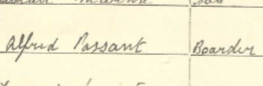
One of the occupational hazards of family history research is becoming distracted by people who aren’t actually related to you. It usually begins innocently enough, with an unfamiliar name appearing in a census return, a witness on a marriage certificate or an individual who seems to turn up rather more frequently than expected. Before long, the original research question has been abandoned in favour of investigating someone whose principal claim to your attention is that they happened to be in the vicinity of an ancestor. This is how I came to investigate Alfred Passant, a man who wasn’t related to me, wasn’t born in the Regency period, and appears to have made a remarkably successful career out of being somebody else’s boarder.
The story began with the 1911 census. I was fine tuning my research into my Martin ancestors in South Wales, examining the household of Benjamin Martin and his wife Elizabeth when I noticed an additional name among the family members. Alfred Passant was recorded as a boarder, unmarried, in his thirties and employed as a coalminer. There was nothing particularly unusual about this. The South Wales coalfield had attracted workers from across Wales and neighbouring English counties, and taking in boarders was a common way for households to supplement their income. Alfred appeared to be one of the many men who had migrated in search of work and found accommodation with an established family. I made a note of him and continued with the research I was actually supposed to be doing.
Then I found him again in 1921. Ten years had passed, the First World War had come and gone, Britain had experienced an influenza pandemic, and the coal industry was embroiled in a major industrial dispute. Alfred, meanwhile, was still living with Benjamin and Elizabeth Martin. He was now recorded as a coal hewer, and there was another interesting detail: Benjamin, Alfred and Benjamin’s son William Alexander Martin were all described as out of work.

The 1921 census was taken on 19 June, during the national miners’ lockout. Following the return of the coal industry to private ownership after wartime government control, employers attempted to reduce wages, prompting a bitter dispute that left miners across Britain without work. The census therefore captures a particularly difficult moment in the economic life of the Martin household. Three men whose livelihoods depended upon coalmining were simultaneously unemployed, and the consequences would have extended well beyond their individual earnings. The records cannot tell us precisely how the family managed financially, but they offer a useful illustration of how national industrial events affected ordinary households. They also showed that Alfred had been boarding with the Martins for at least a decade.
I mentioned this to my mum, and we began wondering who Alfred was. How long could someone reasonably remain a boarder before the arrangement ceased to be temporary and became a permanent feature of the household? It was an innocent enough conversation, and the sensible thing would have been to make a note and return to the question another day. Instead, I opened the electoral registers, which is generally how these things get out of hand.
Twenty-Three Years Later
The electoral registers revealed that Alfred had not only remained with the Martins, but had apparently become something of a permanent fixture. By 1934, he was living with William Alexander Martin and his wife Minnie, whom William had married in July 1923. William had been just seven years old when Alfred appeared in the family’s 1911 census return. More than twenty years later, the two men were still sharing a household, although William was now the householder and Alfred remained the longstanding boarder.
By 1939, all three were living at 25 Colne Street, Newport. Benjamin, meanwhile, had moved to Birmingham, where he was living with another son Francis (Frank), Frank’s father-in-law, and my grandfather Leslie Martin and his siblings. Elizabeth had died in 1936, but both she and Benjamin had been alive when Alfred was already living with William and Minnie in 1934. The arrangement was therefore not simply a consequence of Alfred being left behind following the deaths of his original landlords. Somehow, his association with the family had continued into the next generation, and the records offered no explanation as to why.
At this point, I was becoming rather more interested in Alfred than I had originally intended. A boarder staying for ten years was one thing; a boarder remaining with successive generations of the same family for more than two decades was quite another. I wanted to know who he was, where he had come from, and whether the Martins had always been quite so accommodating.
The Martin Family Boarding Tradition
Looking backwards through the Martin household records revealed that taking in boarders was nothing new. In 1901, Benjamin and Elizabeth had five male boarders living with them, all connected with underground colliery work. Alfred was not among them, so his arrival must have occurred later, at least as far as the surviving census evidence shows. Nevertheless, the household had clearly been accustomed to accommodating working men long before Alfred appeared in 1911.
Boarding arrangements were an important feature of industrial life in the nineteenth and early twentieth centuries, particularly in rapidly expanding coalfield communities. The development of the South Wales coal industry attracted workers from rural Wales, the English border counties and further afield, many of whom arrived without families or established homes. For these men, boarding with an existing household offered a practical solution to the problem of accommodation. For the householders, it provided an additional source of income, although the arrangement was not necessarily as straightforward as simply collecting rent.
The domestic implications are worth considering. Five additional men employed underground would have required feeding, washing and somewhere to sleep, often around shifts dictated by the colliery rather than the household clock. The census records their occupations but tells us very little about the work involved in maintaining the household. Elizabeth’s contribution is largely invisible in the official record, although it is difficult to imagine that accommodating five miners did not substantially increase her domestic responsibilities. Coal dust, washing, cooking and the general business of keeping a household functioning would have been considerable undertakings, particularly alongside raising children of her own. The economic value of boarding income should therefore be considered alongside the labour required to earn it.
As Benjamin and Elizabeth’s family grew, it is possible that they accommodated fewer boarders because more space was needed for their children. This would be a reasonable explanation for the change between the 1901 and 1911 returns, although the records do not establish that it was the reason. What we can say is that the Martins had experience of accommodating unrelated working men, and Alfred was certainly not the first.
There was also an interesting earlier example of boarding within the family itself. In the 1891 census, Benjamin Martin was recorded as a boarder in the household of William and Mary Smith. The important detail is that William and Mary were actually his grandparents. Despite their established family relationship, Benjamin was described as a boarder, rather than a grandson. This illustrates one of the difficulties of interpreting census terminology too literally. The relationship column records how an individual was described within the household, but it does not necessarily provide a complete account of the relationships between its occupants. We cannot assume that Benjamin paid his grandparents for accommodation, any more than we can assume that Alfred’s relationship with the Martins was entirely financial throughout its considerable duration.

Across three generations, boarding arrangements appear repeatedly in the Martin family records. Benjamin was described as a boarder with his grandparents, later accommodated miners himself, and his son William continued taking in boarders. Indeed, after Alfred’s death, William and Minnie accommodated another couple. The practice was evidently an established feature of the family’s domestic life, although Alfred’s longevity was still rather impressive.
Who Was Alfred Passant?
Having established that Alfred had spent decades living with the Martins, I decided to investigate his life before he arrived in South Wales. This was where a relatively straightforward question began to develop into a considerably more complicated exercise in distinguishing between men who happened to share the same name.
Alfred was born in 1877 in Chirbury, Shropshire, a village close to the Welsh border. His birth was registered in the Forden district of Montgomeryshire, which is geographically consistent with Chirbury but introduces the usual complications when searching historical records by county. His parents were Benjamin Passant and Jane Whittall, although the General Register Office birth index records Jane’s maiden surname as Whettell. The family included Alfred and his three brothers, John and two boys named Arthur, the first of whom died in infancy. His father worked as a lead miner in 1881 and later as a shoemaker.
In the 1891 census, Alfred was fourteen years old, living with his parents in Chirbury and recorded as a scholar. By 1911, he was working as a coalminer in South Wales. Somewhere between those dates he had left home, travelled to the coalfield and established himself in employment. This was not an unusual migration pattern. The growth of the South Wales coal industry created opportunities for men from neighbouring agricultural and mining communities, and movement across the Welsh border was an established feature of the region’s economic history. Alfred’s father had himself worked in mining, although we have no evidence that this directly influenced Alfred’s choice of occupation.
Unfortunately, the intervening twenty years are not entirely straightforward to reconstruct, because Alfred has so far resisted identification in the 1901 census. This is not because there are no records for men named Alfred Passant. There are several, which is just enough to make the investigation irritating without providing anything resembling a satisfactory answer. An older Alfred appears in the Shropshire records, apparently belonging to another Passant family. Another Alfred was employed as a rural postman in Herefordshire in 1901, and a Post Office appointment notice from 1899 initially appeared to offer a promising lead. Unfortunately, the ages, birthplaces and family relationships do not establish that either man was the Alfred who later boarded with the Martins.
The situation is not helped by the fact that Alfred’s father Benjamin appears under the surname Poissant in the 1901 census, demonstrating that the family name was not immune to creative transcription. Anyone who has spent time searching census records will know that an ancestor can apparently disappear for a decade simply because somebody has been unusually imaginative with their handwriting.
I have searched alternative spellings, considered the possibility that Alfred was already living in South Wales by 1901, and investigated several individuals who initially appeared plausible but ultimately proved to belong elsewhere. It remains possible that he was recorded under an unexpected spelling, with an inaccurate age or birthplace, or in a household that has not been correctly indexed. It is also possible that he was omitted from the census altogether. For now, Alfred’s whereabouts in 1901 remain unknown.
What had begun as a conversation with my mum about an unusually persistent boarder had developed into an investigation involving several apparently unrelated Passant families, nineteenth-century registration districts, Post Office appointments and the geographical distribution of Shropshire villages. None of this had been part of my original research plan, although by this stage I was sufficiently invested in Alfred’s whereabouts to regard abandoning the investigation as a personal defeat.
The Final Years
Having investigated Alfred’s earlier life, I returned to the records to see just how long Alfred overstayed. The 1939 Register placed him at 25 Colne Street with William and Minnie Martin, and his death registration confirms that this remained his usual address in 1951. By then, Alfred was a retired coalminer, having spent much of his adult life in an industry that had undergone enormous changes since his arrival in South Wales.
On 30 March 1951, Alfred died at the Royal Gwent Hospital in Newport while undergoing a prostatectomy. His death was attributed to cardiac and respiratory failure resulting from operative shock and anaesthesia, and an inquest held on 5 April returned a verdict of accidental death. The circumstances were reported in the local press under the headline Death Under Anaesthetic at Newport. It is a rather abrupt ending to a life that had otherwise left relatively little trace in the newspapers, but the report provides an important final connection to the Martin family. Alfred’s body was identified by William Alexander Martin.

According to the newspaper account, William told the inquest that he thought Alfred had relatives. It is a small detail, but an intriguing one. We know that Alfred had brothers and other family connections in the Welsh border region, yet William’s reported statement suggests some uncertainty about whether relatives were still living or available. It would be tempting to interpret this as evidence that Alfred had become estranged from his family, but that would be going considerably further than the source permits. He may simply have lost contact, rarely discussed his relatives or left William uncertain about their whereabouts. We cannot establish the nature of Alfred’s relationship with his birth family from this brief remark.
What we can establish is that William had known Alfred since childhood and was the person who identified him following his death. Their association had lasted at least forty years, spanning William’s childhood, marriage and adult life. Whatever Alfred’s position within the household, he had remained a consistent presence across much of William’s life.
A Find a Grave memorial places Alfred at St Woolos Cemetery in Newport, where some members of the Martin family are also buried. The memorial gives a date of 4 April 1951, which differs from the official death registration, and also records a birth year inconsistent with the earlier birth index. These discrepancies are useful reminders that online memorials, like all secondary sources, should be checked against contemporary records wherever possible. Whether Alfred shares a grave with any members of the Martin family, or whether William arranged his funeral, remains unknown.
The original cemetery records might answer some of these questions, but obtaining them could involve a fee, and I feel I have already devoted a substantial amount of unpaid research to someone who is not actually related to me. There are limits, even for genealogists.
The Man Who Came to Stay
What began as a minor curiosity in the 1911 census has become an unexpectedly revealing piece of family and social history. We cannot establish precisely when Alfred arrived, why he remained or what the Martins thought of him. The records do not tell us whether he was regarded as a friend, a member of the extended household or simply a reliable boarder. They establish an enduring association, but not the personal feelings behind it. It would be satisfying to conclude that Alfred became part of the family in every meaningful sense, but that would be a story imposed upon the evidence rather than one demonstrated by it.
Nevertheless, his presence raises an interesting question about what we choose to include in family history. A pedigree records biological descent and legally recognised relationships, but it does not necessarily capture the people who shared our ancestors’ homes and everyday experiences. Lodgers, servants, apprentices, neighbours and unrelated workers could play significant roles in family life, even though they have no obvious place in a conventional family tree. Their presence can also reveal aspects of the household economy, migration patterns and social relationships that might otherwise be overlooked.
Alfred has no established place in my family tree, but he certainly has a place in my family’s history. He shared the Martins’ experience of industrial employment and unemployment, remained with them as their children grew into adults, and continued living with the next generation long after his original landlords had moved elsewhere or died. When he died, it was William Martin who identified him.
I cannot tell you whether Alfred was particularly loved, exceptionally useful or simply very good at finding accommodation. I suspect the truth may have been more ordinary, and more complicated, than any neat explanation would allow. What I can say is that he moved into a Martin household, remained associated with the family for approximately forty years, and has subsequently occupied a quite unreasonable amount of my research time despite not being related to me at all.
Sources and Research Notes
The investigation draws on the following historical records:
- General Register Office birth index: Alfred Passant, registered January–March 1877, Forden registration district, mother’s maiden surname recorded as Whettell.
- 1891 census: Alfred Passant living with his parents Benjamin and Jane in Chirbury, Shropshire.
- 1901 census: Benjamin and Elizabeth Martin’s household, including five boarders employed in the coal industry. Alfred Passant has not been conclusively identified in this census.
- 1911 census: Alfred Passant, coalminer and boarder in the household of Benjamin and Elizabeth Martin.
- 1921 census: Alfred Passant, coal hewer and boarder in the Martin household, recorded as out of work during the national miners’ lockout.
- Electoral registers, 1934: Alfred Passant living with William Alexander and Minnie Martin.
- 1939 Register: Alfred Passant living with William and Minnie Martin at 25 Colne Street, Newport; Benjamin Martin living in Birmingham.
- Death registration and inquest, 1951: Alfred Passant, died 30 March 1951 at the Royal Gwent Hospital, Newport; inquest held 5 April 1951.
- Contemporary newspaper report: Death Under Anaesthetic at Newport, recording the circumstances of Alfred’s death and William Alexander Martin’s identification of his body.
- Find a Grave memorial: Alfred Passant, St Woolos Cemetery, Newport. The memorial’s birth and death dates differ from those established by civil registration records.
The precise date of Alfred’s arrival in the Martin household, his whereabouts in 1901, the nature of his personal relationship with the family and the arrangements surrounding his burial remain unresolved.





Leave a Reply