
A few weeks ago I wrote an article about why historians are perfectly entitled to enjoy Bridgerton. It seemed to strike a chord with quite a few people, perhaps because so many of us feel we have to choose between enjoying history and enjoying fiction. Personally, I’ve never seen the conflict. I can happily spend a day reading parish registers and then settle down in the evening to watch a lavishly inaccurate Regency drama. One feeds my curiosity, the other simply entertains me.
As it happens, that reason for that article led to me spending a Monday evening in London.
The reason was simple enough. Luke Thompson was performing in White Rabbit, Red Rabbit at the Duchess Theatre, and after much deliberation – by which I mean about three minutes – I decided this seemed the perfect excuse for a little adventure. I booked a hotel, packed an overnight bag and looked forward to a day entirely in my own company. It turned out to be one of those days that reminds you how enjoyable your own company can actually be.
I arrived at the theatre with plenty of time to spare and found my seat. The lady beside me was also attending on her own, so naturally we started chatting while we waited for the performance to begin. Within a few minutes she’d told me she’d travelled from the United States specifically to see the play. That made my train journey from Portsmouth seem rather less impressive.


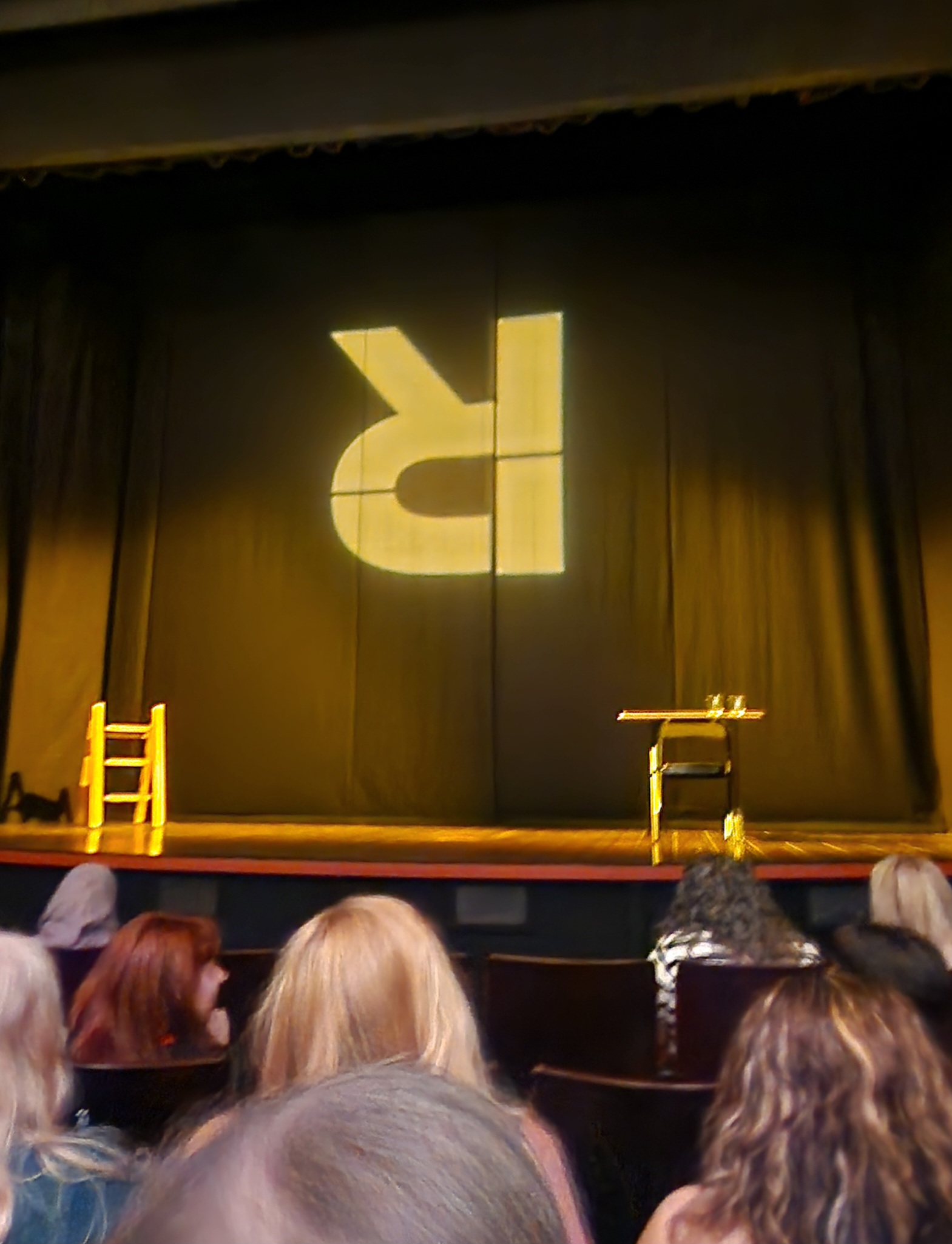
The simplest of stage sets proved that the most memorable performances rarely rely on elaborate scenery
As we talked, it became clear that this wasn’t simply a theatre trip. She’d travelled to see several members of the Bridgerton cast perform on stage over the past couple of years and produced a well-loved copy of Julia Quinn’s An Offer From a Gentleman. She was hoping Luke Thompson might sign it afterwards. It already carried the signature of Yerin Ha, whom she’d met after seeing The Maids in New York.
Then, quite casually, somebody sitting in front of us turned around.
“You do know Yerin’s here?”
For a moment I wasn’t entirely sure I’d heard correctly. As it happened, she was sitting just three rows behind us.
There followed one of those slightly surreal moments where you very carefully glance over your shoulder, trying not to look as though you’re glancing over your shoulder. Sure enough, there she was, chatting away before the performance like everyone else in the audience. It was oddly grounding. We become so accustomed to seeing actors through a screen that it feels strangely unexpected to remember they’re simply people who also go to the theatre.
The play itself was unlike anything I’ve ever experienced. It’s one of those productions that’s almost impossible to describe without spoiling it for somebody else, so I shall resist the temptation. What I will say is that it managed to be funny, moving, uncomfortable and genuinely thought-provoking, often within the space of a few minutes. Several audience members unexpectedly found themselves becoming part of the performance and embraced the challenge brilliantly.
By the end of the evening, they had become minor celebrities themselves. As we all filed out of the theatre, complete strangers congratulated them on their performances as though we’d known them for years.
Then, just as unexpectedly as it had begun, it ended. No bows. No curtain call. No cast lined up across the stage. Just… the end. I’ve never walked out of a theatre feeling quite like that before.

Outside, a sizeable crowd had already gathered near the stage door. Some people held copies of An Offer From a Gentleman. Others had posters carefully rolled beneath their arms. Everyone shared the same quiet optimism that Luke Thompson might appear for a quick autograph or simply to say hello.
While we waited, I found myself chatting to more people. Canada. Costa Rica. Spain. Brazil. South Korea. The conversations all began in much the same way.
“So… where have you travelled from?”
Some had planned holidays around the performance. Others had booked flights specifically to see Luke on stage. Quite a few hoped they might also catch a glimpse of Yerin Ha.
What struck me wasn’t really the distances people had travelled, remarkable though they were. It was how quickly complete strangers became friends. We stood there comparing journeys, favourite performances and holiday plans as though we’d arrived together. Even the audience members who had found themselves on stage became part of the conversation, with everyone congratulating them and laughing about their unexpected moment in the spotlight.
Eventually a member of staff emerged to explain that Luke had already left through another exit. A collective sigh drifted through the crowd.
Most people accepted the news with good humour, although a determined handful remained convinced he would somehow appear later if they simply waited long enough.
I said goodbye to my newfound international friends and decided that, tempting though another hour beside the stage door might have been, a slow walk back to the Tube station was in order. It turned out to be an excellent decision. Amorino was still open as I passed, and a hazelnut chocolate and tiramisu ice cream quickly became part of the evening.

Rather than heading straight for Waterloo, I wandered along the Thames on a warm July evening, watching the lights dance across the water. At one point a brightly lit BTS advertising boat drifted past, which somehow felt entirely appropriate after such an unusual day. London does have a habit of producing moments that sound faintly ridiculous when you recount them later.
As I walked, I found myself wondering whether any of this would have seemed familiar two hundred years ago. Not Luke Thompson, of course. Not Bridgerton. Not stage-door selfies. But everything else.
Would somebody in the Regency have travelled across the country to see their favourite actor? Would complete strangers have struck up conversations simply because they shared an admiration for the same performer? Would audiences have gone home talking excitedly about one extraordinary evening in the theatre? The answer, it turns out, is yes.
If there was one actor capable of inspiring that sort of enthusiasm during the Regency, it was Edmund Kean. Kean made his London debut at the Theatre Royal, Drury Lane in 1814 as Shylock in The Merchant of Venice, and almost overnight became one of the most talked-about men in Britain. Like Thompson, Kean appeared in several of Shakespeare’s plays in the titular role. Contemporary newspapers described audiences captivated by the intensity of his performances, while critics struggled to find enough superlatives to explain quite what made him so remarkable. People queued for tickets, performances sold out, and everyone seemed to have an opinion on the actor who had transformed Shakespeare into something fresh and electrifying.


Edmund Kean’s name takes pride of place on this 1822 Drury Lane playbill, reflecting his extraordinary popularity during the Regency.
The remarkable thing is that you didn’t have to belong to fashionable London society to know who Edmund Kean was. His performances were reported far beyond the capital. Provincial newspapers reprinted reviews and theatrical gossip from London, meaning people who might never visit Drury Lane could still follow his career. Travellers carried stories home after visiting the capital. Cheap engraved portraits allowed admirers to own his likeness, while biographies and memoirs appeared during his lifetime. If you lived in York, Exeter or Carlisle, you may never have seen Edmund Kean perform, but you would almost certainly have heard his name.
Reading about him, I couldn’t help smiling. Yesterday I met people who had crossed oceans to spend a single evening in a London theatre. Two hundred years ago, people journeyed to the capital to see Edmund Kean because they simply had to witness the performance everyone was talking about.
As I sat at Waterloo the following morning, waiting for my train home and writing these thoughts before everyday life took over once more, I realised my favourite part of the trip hadn’t actually been spotting Yerin Ha or even watching an extraordinary play. It had been meeting people.
People from different countries, different backgrounds and different walks of life who all happened to converge on one small theatre in London because, for one evening, we wanted to share the same experience.
Perhaps someone leaving Drury Lane after watching Edmund Kean in 1814 also walked home replaying every scene in their mind, talking excitedly with strangers, and wondering when they might manage to see him perform again.
Some things, it seems, never really change.





Leave a Reply