One of the biggest misconceptions about history is that historians spend their lives memorising dates and collecting facts. In reality, facts are only the starting point. Historians are interested in evidence: where it came from, why it was created, how reliable it might be and what it can tell us about the people who left it behind.
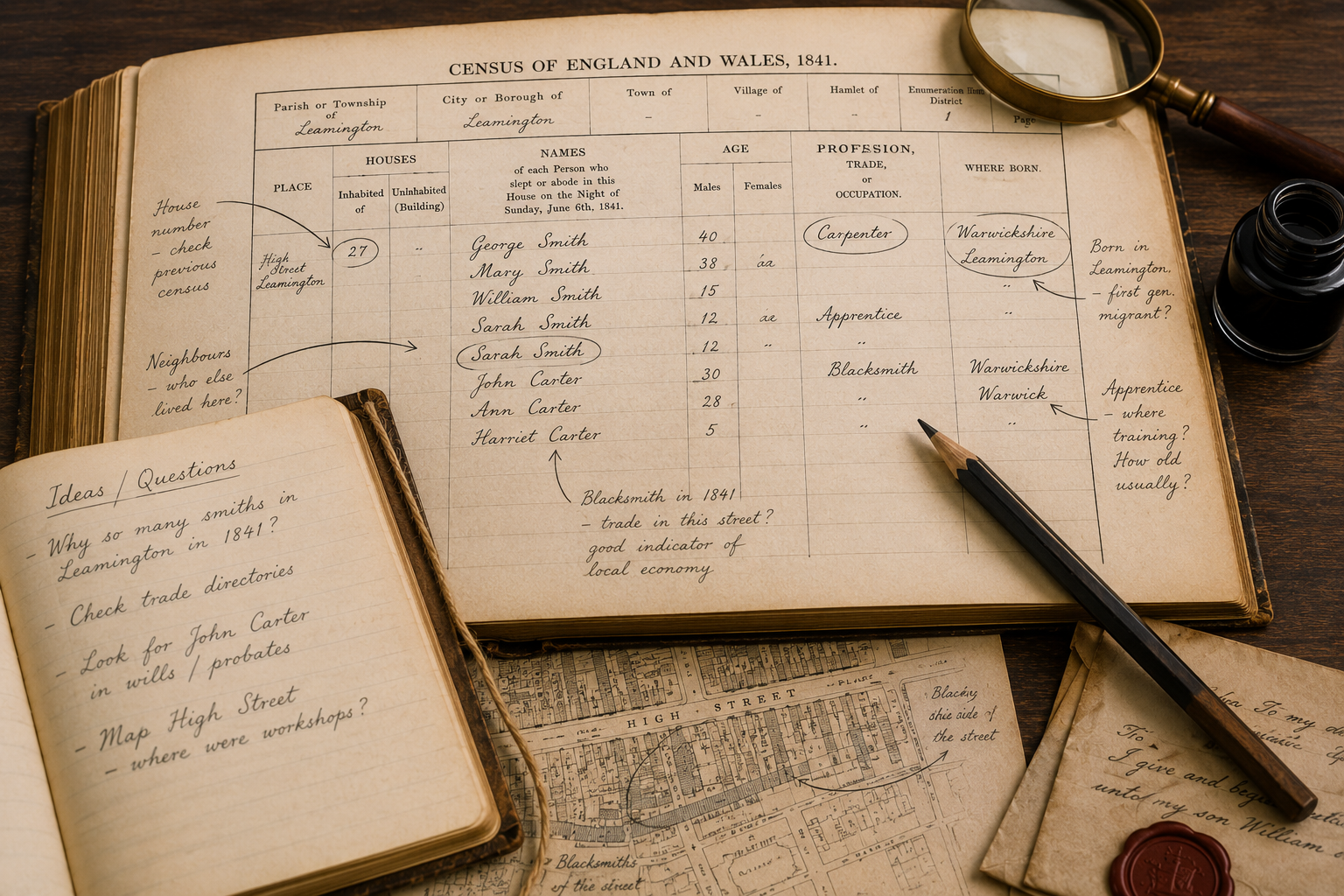
Family historians often have access to exactly the same evidence. Parish registers, census returns, wills, newspapers, maps, tax records and military records all survive for us to explore. The difference is not the records themselves but the way we read them. While it’s tempting to think genealogy is about discovering another generation or finding another certificate, the real skill lies in learning to ask better questions of the records we already have.

The good news is that this isn’t something reserved for professional historians. Anyone can learn to think this way, and doing so often transforms family history from a collection of names and dates into something much richer.
Every record has a purpose
Historical records were never created with future genealogists in mind. Every document exists because somebody needed it for a particular reason. Parish registers recorded baptisms, marriages and burials for the Church. Census returns were compiled to help governments understand the population. Land tax assessments existed to raise revenue. Poor Law records administered relief, while military and employment records supported the day-to-day running of organisations.
Understanding why a record exists immediately changes how we interpret it. A census was never intended to provide a complete biography of a family. It simply recorded who was present on one particular night. Likewise, a death certificate reflects the knowledge of the informant, which may be entirely accurate or surprisingly limited. Every source has strengths, but every source also has limitations.
Rather than asking, “What does this record tell me?”, historians often begin by asking, “Why was this record created?” The answer usually explains both what has been included and what has been left out.
Historians are comfortable with uncertainty
One of the first things every family historian discovers is that records frequently disagree with one another. Ages drift between census returns, birthplaces vary, occupations change and surnames acquire seemingly endless alternative spellings. Our instinct is often to identify which record is “right”, but historians tend to approach the problem differently.

Historical records were created by people, and people make mistakes. Some genuinely didn’t know their exact age. Clerks misheard names. Enumerators misunderstood accents. Information was copied from earlier documents, sometimes introducing fresh errors along the way. Rather than seeing these inconsistencies as obstacles, historians recognise them as clues. If two records disagree, the question becomes not simply which is correct, but why they differ in the first place.
That willingness to live with uncertainty is one of the most valuable research skills we can develop. Good genealogy is not about proving ourselves right. It is about following the evidence wherever it leads, even if that means abandoning conclusions we previously felt confident about.
One record is interesting. Several records become evidence.
Perhaps the greatest difference between collecting information and conducting research is understanding that no document should be read in isolation. Every historical source offers one perspective on a person’s life, but it is only when multiple records are brought together that meaningful patterns begin to emerge.
I was reminded of this while researching my ancestor Francis Anderton. Parish registers established his family, census returns recorded where he lived and his changing occupation, while land tax records identified the estate where he farmed before later moving into Birmingham. On their own, each document offered only a small piece of information. Read together, however, they revealed something far more interesting: the gradual transition from rural tenant farming to urban employment, alongside a series of devastating family bereavements that fundamentally changed the course of his later life. None of those records explicitly tells that story. It only emerges when each piece of evidence is considered alongside the others.
Professional historians rarely rely on a single document when reconstructing the past, and family historians shouldn’t either.
Context gives records their meaning
Finding an ancestor described as a labourer, shepherd or servant is useful. Understanding what those occupations meant at a particular point in history is far more valuable. The same occupation could involve very different experiences depending on where someone lived, the state of the economy or the wider events unfolding around them.
One of my Irish ancestors, Thomas Glynn, appears in surviving records as a shepherd, later as a labourer in Birmingham and eventually as an inmate of the workhouse. Read as isolated entries, those records simply document changes in occupation and residence. Place them alongside the wider history of nineteenth-century Ireland, migration to industrial towns and the realities of poverty in later life, and they become chapters in a coherent life story. History provides the context that allows genealogy to move beyond description and towards understanding.
This is one of the reasons I enjoy social history as much as genealogy. The more we learn about the world our ancestors inhabited, the more sense their decisions begin to make.
Good researchers ask better questions
Perhaps the most important lesson family historians can borrow from professional historians is the habit of asking questions that go beyond the obvious:
- Who created this record?
- Why was it created?
- Who might have supplied the information?
- What has been left out?
- Does another source support or contradict it?
- What else was happening in this person’s life or community at the time?

Those questions rarely produce instant answers, but they almost always lead to better research.
One of the most useful lessons my own family history has taught me came while untangling several women named Elizabeth Harris. At various points, different records appeared to support different conclusions, and it would have been remarkably easy to force the evidence into the story I expected to find. Instead, I had to accept uncertainty, compare every available source and remain open to the possibility that my original assumptions were wrong. That experience reinforced something historians have understood for generations: evidence should shape our conclusions, not the other way around.
Becoming your own historian
It’s easy to measure success in genealogy by the number of generations we’ve traced or the size of our family tree. There is certainly satisfaction in discovering another ancestor, but increasingly I think the most rewarding research comes from understanding the people we have already found.
The next time you open a census return, parish register or newspaper, pause before copying the names and dates into your software. Ask why the record exists. Consider what it doesn’t tell you as well as what it does. Compare it with other sources, place it within its historical context and allow yourself to leave questions unanswered until further evidence appears.
You may not add another generation to your tree that evening, but you will almost certainly come away with a deeper understanding of the people already on it.
For me, that’s what family history is really about. Not simply collecting names, but learning to think critically about the evidence they left behind. When we begin to approach our research as historians do, our ancestors gradually become more than entries in a database. They become real people, living ordinary lives within extraordinary periods of history, and that is a far richer story to uncover.