To trace Irish ancestry is to follow a trail that is at once abundant in promise and curiously reluctant to reveal its full hand. One may begin with confidence, only to find the past behaving with a most uncooperative discretion, offering fragments where certainty was expected, and hints where clarity was desired. And yet, it is precisely within these elusive traces that the more compelling story begins to form… though, as ever, the full account is reserved for those sufficiently curious to continue.
To explore Irish ancestry is to engage not only with family history, but with the layered and often fragile record of a nation shaped by profound change. It is a pursuit that requires both diligence and a certain humility, for the archives do not always yield their truths readily, and in some cases, they no longer exist in full.
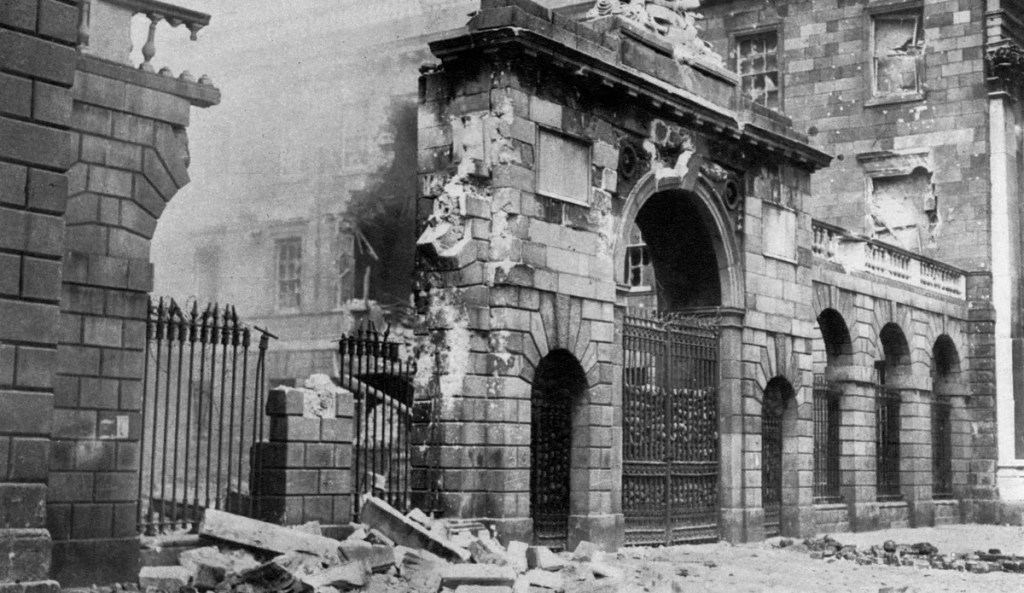
One of the most consequential losses to Irish genealogical research occurred in 1922, during the Irish Civil War, when the Public Record Office at the Four Courts in Dublin was destroyed following an explosion and subsequent fire. The blaze consumed centuries of state records, including the 19th-century census returns, wills, probate records, and Church of Ireland parish registers dating back to the 16th century. For family historians, this was not merely an administrative setback but an irreplaceable rupture in the documentary fabric of Irish life. Entire generations were, in effect, rendered partially invisible in the archival record.
There are census fragments that survived: 1901 and 1911, both of which remain invaluable and wonderfully detailed, listing everything from age and occupation to literacy and language spoken. One might almost imagine ancestors pausing mid-pen stroke to consider whether admitting they spoke Irish Gaelic would improve or hinder their prospects.
This loss must be understood within a longer historical continuum. To properly interpret Irish genealogical research, one must also look further back into the late 18th and early 19th centuries, a period often loosely associated with the Regency era elsewhere in the British Isles, but in Ireland marked by its own distinct political and social realities.
Following the Act of Union in 1801, Ireland became formally incorporated into the United Kingdom. This period saw increasing centralisation of administration, yet also deepening social division. The Penal Laws, though gradually eased by the early 19th century, had already left a lasting legacy on Catholic land ownership, education, and record-keeping. As a result, many Irish ancestors appear in historical documentation not as individuals richly detailed, but as tenants, labourers, or names recorded indirectly through estate and land records.
For genealogists, this is where some of the most valuable surviving sources emerge. The Registry of Deeds, established in 1708, offers insight into property transactions among landowners and tenants. Though it does not record every individual, it can provide critical links between families, townlands, and estates. Similarly, the Tithe Applotment Books (compiled between 1823 and 1837) record agricultural landholders liable for tithes to the Church of Ireland, offering a snapshot of rural Ireland prior to the Great Famine.
It is also within this broader Regency-to-early-Victorian transition that one observes the slow but significant shift in record-keeping practices. Civil registration of births, marriages, and deaths would not begin until 1864 (with non-Catholic marriages recorded from 1845), meaning that earlier family reconstruction relies heavily on parish registers, many of which survive only in fragments. Catholic parish registers, where they survive, can extend into the 18th century, though coverage varies significantly by region. These records often require careful interpretation, as spelling inconsistencies were common and Latin was frequently used in earlier entries.
Language itself is an additional consideration. Many Irish ancestors lived in bilingual or Irish-speaking communities, particularly prior to 1845. Names and place names may appear in anglicised or Gaelic forms, sometimes within the same family line. This fluidity can complicate searches but also reflects the cultural complexity of Ireland during this period.
This era was also one of social tension and occasional upheaval. The early 19th century saw agrarian unrest, population growth, and increasing pressure on land resources. These conditions contributed to patterns of migration, as families sought stability within Ireland or began to establish connections abroad, particularly in Britain and North America. Such movements are frequently reflected only indirectly in records, through absences in parish registers or the appearance of family members in foreign censuses and immigration documents.
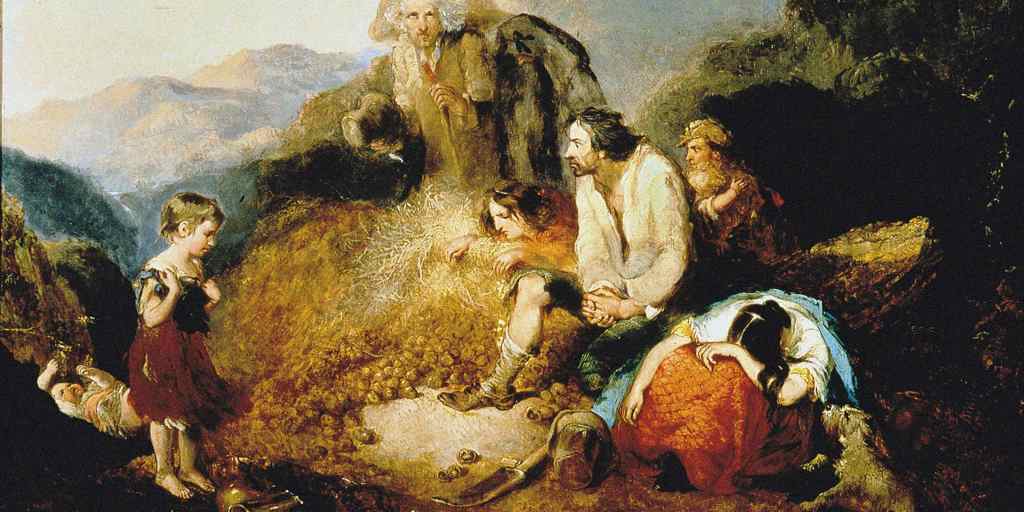
To understand Irish ancestry fully, however, one must also confront the defining tragedy of the 19th century: the Great Famine (1845–1852), known in Irish as An Gorta Mór. During this period, a potato blight (Phytophthora infestans) devastated the staple crop upon which much of the population depended. The result was catastrophic. Approximately one million people died, and at least another million emigrated, reducing Ireland’s population by around 20–25% in just a few years.
The impact of the Famine was deeply unequal. Tenant farmers and rural labourers, already living on marginal holdings under the system of land tenancy, were disproportionately affected. While food continued to be exported from Ireland during the period, many families were unable to afford what was available locally, a reality that has shaped historical interpretation and remains a subject of careful scholarly study.
For genealogists, the Famine years present a profound challenge. Parish records may thin or cease entirely in certain areas due to displacement, death, or the collapse of local infrastructure. Entire family lines disappear from one record set only to re-emerge, if at all, in immigration documents abroad. The Irish diaspora, particularly in Britain, the United States, Canada, and Australia, expanded dramatically during and after this period, making passenger lists, workhouse records, and naturalisation documents essential tools in tracing family movements. However, caution is urged here – there is no official list of families that moved from Ireland to Great Britain during this time. Movement between the two islands was considered domestic travel and formal passenger lists and migration records were not kept.
One particularly valuable source is the Griffith’s Valuation, conducted during the time of the Great Famine (1847-1864). This nationwide property survey lists occupiers of land and buildings, effectively functioning as a mid-19th-century census substitute. It does not record every individual within a household, but it often provides the crucial link between a family name and a specific townland, an essential geographical unit in Irish genealogy that can determine whether one has found the correct branch of a family or wandered into an entirely different one.
In approaching the records, one must also acknowledge the human dimension behind the archive. Each entry in a census, each line in a parish register, represents a life lived under conditions very different from our own, often shaped by economic uncertainty, religious constraints, and social upheaval. The task of the genealogist, therefore, is not only to assemble lineage, but to interpret context with care.
And so we return to where we began: the challenge of absence. Whether caused by the destruction of the Public Record Office in 1922, the fragmentary nature of earlier parish records, or the silent disruptions of famine and migration, Irish genealogy is often characterised by what is no longer there. Within these silences lies a different kind of truth; one that requires patience, sensitivity, and an understanding that history is preserved as much in gaps as in surviving records.
In a future instalment, I shall, dear reader, recount my own foray into my Irish roots. I am currently experiencing a troublesome time with understanding how my own Irish ancestors came to move to and settle in Birmingham in the 19th Century. This is an endeavour marked by no small number of dead ends and the ever-infuriating phenomenon I’ve affectionately named the “Wrong John” trail.
But that’s a story for another day…

 Regency Relatives
Comments, insights, and gentle corrections welcome.