
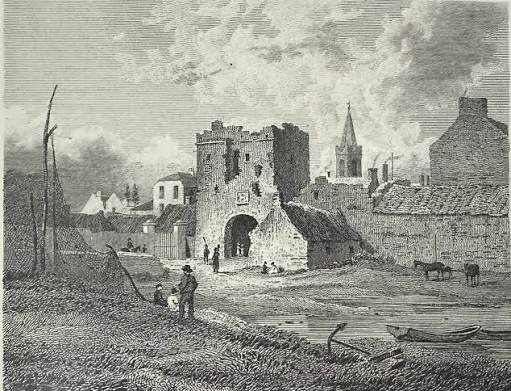
Some family histories arrive with neat documentation and a reassuring sense of order, or so I am told. Mine don’t seem to cooperate with that idea. What I tend to find instead are lives that move quite fluidly between place to place, or career to career, leaving traces in parish registers and census returns that only really make sense when set alongside the wider social history of the period. This is another of those stories, following a family from Athlone to Loughrea and into industrial Birmingham, where labour, migration, and the workhouse sit uncomfortably close together within the everyday workings of a rapidly changing society.
As regular readers will know, my research into family history sits alongside a broader interest in Regency life, particularly the gap between how the period is often presented on screen and how it functioned in practice. Regency England is usually imagined as a world of refinement: drawing rooms, etiquette, carefully staged displays of gentility. Once parish records, census returns, and poor law documentation are brought into view, a different version of the same society emerges. It is less polished, more precarious, and far more concerned with survival than with appearances.
Birmingham sits right at the centre of that contrast. During the Regency period it was not a landscape of rural leisure or aristocratic ease. It was a rapidly expanding industrial town: noisy, densely worked, and shaped by metal trades, manufacturing, and constant inward migration. Workshops appeared and disappeared quickly, and people arrived in search of work in large numbers. Stability was never guaranteed, even for those in regular employment. That instability matters, because it forms the backdrop to how poverty was managed.
Poverty relief was locally administered, and eligibility depended on settlement, timing, and the judgement of parish officials. Support existed, but it was never automatic. Birmingham developed a relatively structured response to this responsibility. Its workhouse on Lichfield Street, near the site of Birmingham Children’s Hospital today, was established in the 1730s, and so was already a substantial institution by the late eighteenth century. In 1852, a new workhouse was built in Winson Green, the site of which is now City Hospital.

Life inside the workhouse was tightly regulated. Food was basic and rationed, clothing issued, and daily routines strictly enforced. The system was designed around order and deterrence as much as relief. Bread, broth, repetition, and routine defined the structure of the day. At the same time, the workhouse was not only a place of final entry. It functioned as part of a wider system of temporary support, and movement in and out was relatively common in a city where employment itself was unstable.
That wider framework becomes clearer when placed alongside the trajectory of one family.
My five times great grandfather, Thomas Glynn, was born in Athlone, County Westmeath in Ireland in 1799. Athlone was a garrison and market town on the River Shannon. Its economy combined military presence, trade, and agricultural exchange, producing a mixed environment of labouring work, service roles, and seasonal employment.

In his early life, Thomas, a Roman Catholic, is recorded as a shepherd; a form of labour that was not fixed to a single place, but moved with opportunity. Shepherding in early nineteenth century Ireland was typically tied to estate farming and pastoral land use, often on rural holdings rather than within towns themselves.
Thomas married Marie Powell in 1832 and their son John was born in 1835. At this time, the family was established in Loughrea, County Galway. Loughrea was a smaller market town embedded in a strongly agricultural region, shaped by tenant farming and seasonal labour. Compared to Athlone, it was more rural in character and more directly dependent on land-based economies. Shepherding would still have been a plausible continuation of Thomas’s working life.
In February 1839, Thomas appears in the prison records, spending at least a night in Galway Gaol for drunkenness, alongside a long list of others. Drunkenness was treated as a summary offence, part of a wider tightening of public order rather than anything resembling long term imprisonment. It is impossible not to wonder about the gap between the brief record and reality here. Was this a night that simply ran away from Thomas, or an ordinary misstep that happened to meet the wrong authority at the wrong time. Were the drunken others locked up with him his friends joining in on a raucous night in the tavern? And what did Marie make of this?! Galway Gaol itself was as you would expect from a Regency period prison; overcrowded and basic, with limited sanitation and minimal comfort even for short stays.

By 1841 the family had left Ireland. Thomas and Marie’s second son George was born in Birmingham that year, marking the point at which they enter English records. This is also where the limits of Irish migration records become apparent. Movement between Ireland and Great Britain was not formally documented in the way we might expect today. After the Act of Union joined Ireland and Great Britain to form the United Kingdom in 1801, movement between the two islands was considered domestic travel. People simply disappeared from Irish sources and reappeared in English ones, with no official record of the journey. More on the social history of Ireland, and what may have led to the Glynn family migrating to England, can be found in my earlier post, Irish Genealogy: a Study in Silence.
In 1841, Birmingham was one of the fastest expanding industrial cities in Britain. Birmingham’s economy was driven by manufacturing, metalwork, and construction, and it relied heavily on unskilled and semi skilled labour. Irish migrants formed a significant part of that workforce. Within this environment, Thomas is again recorded as a shepherd, in the record of his son John’s marriage. I find myself pausing over that description again. In a rapidly industrialising city, it is an unusual finding. I think it likely reflects work on the semi rural outskirts or within supply networks still connected to surrounding agricultural land, rather than anything pastoral in a conventional sense. I also wonder if could also be a sign that Thomas wasn’t able to secure a new trade more fitting of his new city-based residence.

Thomas’ son John married Mary Lally in 1853, and in the 1871 census, John is recorded living in Sheep Street, Aston, Birmingham, with his own household and his brother George lodging with him. Both are listed as labourers, a term that generally denoted irregular, physically demanding work in construction, manufacturing, or transport, with income that shifted according to demand. Like their parents, the newer Glynn family were likely living life precariously on the breadline.
But what of Thomas at this time?
In 1871, Thomas reappears in the records and is recorded as an “inmate” in Birmingham Workhouse in Winson Green. The census records showed the scale of poverty in Birmingham during this time, with hundreds of other inmates named as residing in the workhouse on the day of the census. There appears to be no reference to Thomas’ wife Marie in this record, and she doesn’t seem to be living with her sons, so an assumption could be made that she has unfortunately passed.
I find myself wondering what actually led Thomas to the workhouse, especially when his sons were nearby in Birmingham and, at least on paper, part of the same urban network. Whether there was a practical reason we can no longer see in the record, a stretch of financial pressure that made co-residence impossible, or something more personal like a family disagreement that never made it into official documentation, we simply do not know. It is also entirely possible that the arrangement was shaped by a quieter kind of constraint: limited space, unstable work, or the simple arithmetic of survival in an industrial city. And then there is the more human possibility that does not appear in any census or register: that Thomas chose not to be a burden. In the end, the record gives us the outcome, but keeps the reasoning firmly to itself.
There is a civil register entry recording that Thomas died in April 1872. It is unusual that no parish burial record appears alongside it, especially for someone of Roman Catholic faith. It raises quiet questions. Might he have lacked the means for a formal burial, or perhaps spent his final days in the workhouse? Or could there still be records waiting to be uncovered? For now, the details surrounding the end of Thomas’s life remain uncertain, a small but poignant mystery I will keep working to understand.
Taken together, Thomas Glynn’s life, and the family that follows from it, sits neatly within the broader currents of nineteenth century movement and survival rather than standing apart from them. From Athlone in 1799 to Loughrea in the 1830s, and then across the Irish Sea into Birmingham by 1841, the record traces a familiar pattern of Irish rural labour meeting the pressures and possibilities of an expanding industrial England. Within Birmingham, Thomas’s likely continued association with rural work sits apart from his sons’ lives as labourers in a densely working urban environment, but each generation was shaped by the same unstable rhythms of employment and security. By 1871, those trajectories further converge: John and George embedded in the precarious but ongoing world of city labour, and Thomas, aged 72, recorded within the workhouse system that had become one of Birmingham’s central mechanisms for managing old age and poverty. Read together, the records do not describe an exceptional fall so much as they reveal how ordinary and structurally embedded these movements between work, family, and institutional care could be in a city and century defined by change.





Leave a Reply