
Set against the rise of England’s nineteenth-century coal industry, a life is traced through labour, endurance, and quiet transformation. Beginning in rural Warwickshire and moving into the depths of the coalfields, where identity is shaped by work, responsibility, and change. What emerges from the fragments is not a fixed story, but a life lived within the steady pull of industry, family, and circumstance, where progression is gradual and survival itself becomes a form of continuity.
When I trace my ancestor’s life back to the early nineteenth century, I find myself stepping into a Britain that was changing faster than almost anyone could comprehend at the time. The Regency period sat at the beginning of what we now call the Industrial Revolution’s most intense phase, when coal became the quiet fuel behind nearly every transformation in society. It powered the steam engines that drove textile mills in Lancashire, the ironworks of the Midlands, and increasingly the locomotives that would soon connect the country by rail. Domestic life, too, was changing: coal fires were becoming the norm in homes rather than wood or peat, especially in growing towns and cities. Demand surged, and with it came a dramatic expansion of mining across regions like the Midlands and the North.
It is easy to forget how quickly this all happened. In the late eighteenth century, much of Britain was still rural and agricultural. By the time my ancestor was born in 1802, the country was already being reshaped by machinery, capital investment, and industrial labour on a scale never seen before.
The Warwickshire Coalfield was part of this transformation. Although not as vast as the coalfields of Yorkshire or Durham, it played an important role in supplying fuel to the rapidly industrialising Midlands. Bedworth and nearby Foleshill became increasingly defined by coal mining, with collieries expanding as demand grew. These were not yet the giant industrial landscapes we might imagine from later Victorian paintings, but they were already complex systems of extraction, labour, and transport. Bedworth had a number of “Charity Collieries” stretching across land owned by Nicholas Chamberlaine, a priest of the Church of England, known for charitable donations, who also established a school and almshouses in the area.


George Starkey (1802–1877), my four-times great-grandfather, was born and baptised in Grendon, Warwickshire, into a world that still wore the familiar face of rural England, yet was already beginning to shift beneath the growing weight of industry. He was the son of John Starkey (1765–1840) and Ann Baldwin (1767–1832), one of six children raised in a large household where life would have been shaped by work, seasons, and the quiet demands of survival in late Georgian Warwickshire.
By the time he reached adulthood, the world around him was changing fast. The pull of the coalfields drew him, as it did so many men of his generation, into the deep and demanding work of the pits. He became a collier in Bedworth, part of a workforce that laboured underground to fuel the furnaces, steam engines, and fires that were reshaping Britain above them. It was work defined by darkness, physical endurance, and risk—but also by a kind of quiet solidarity among men who depended entirely on one another to get through each day.

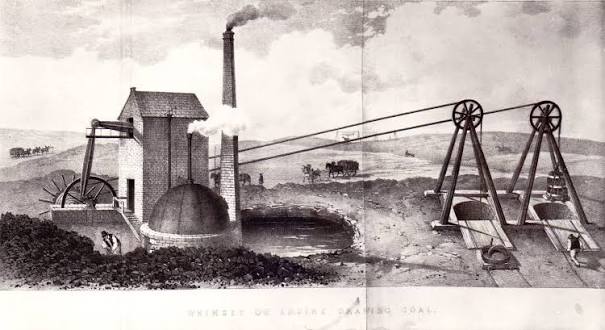
Mining in this period was dangerous, physically demanding, and still only loosely regulated. Coal was extracted through deep vertical shafts leading to narrow seams underground, often worked by men in extremely confined conditions. Lighting came from candles or early safety lamps, ventilation systems were inconsistent, and the risks were very real: firedamp explosions, roof collapses, flooding, and long-term respiratory illness were all part of everyday life for miners. It is sobering to think that much of this was considered simply “part of the job” for decades.
In 1829, George married Rosanna Atkins (1809–1855). I often think of that moment not as a record in a register, but as a beginning carved out of a difficult world: two young people building a life together in a mining community where certainty was rare, but family was everything. Together they had four children, and for a time their household would have been full: children growing up in the shadow of the pits, life measured in shifts, wages, and the steady effort of getting by. It is not hard to imagine how tightly bound their lives must have been to both hope and hardship – joys made small but precious, and losses felt deeply in homes where every pair of hands mattered.
By 1841, the family are living at Coal Pit Field in Bedworth, and George was working as a collier. This was not a picturesque village life; it was a tightly packed mining settlement, where rows of houses clustered around the pits and nearly every family was connected to the industry in some way. These communities were shaped by the rhythm of shift work: men descending before dawn, returning exhausted, blackened by coal dust, while life above ground carried on in its own careful balance of domestic labour, childcare, and survival. This was the foundation of mining life; physically punishing work involving hewing coal by hand, often in cramped seams where men could barely stand upright. Payment was frequently tied to output rather than fixed wages, meaning income could fluctuate with conditions underground or the productivity of the seam. It was hard, unrelenting work, but also the backbone of Britain’s industrial rise.

As the century progressed, so too did mining itself. The Victorian period saw increasing attention to safety and regulation, particularly after public concern about accidents and child labour. The Mines and Collieries Act of 1842, for example, prohibited women and children from working underground, marking a significant turning point in mining labour practices. Engineering developments also began to change the industry: steam-powered winding engines, improved pumps for drainage, and more structured systems of management all gradually reshaped how mines operated.
And in 1851, I find something that reflects this change in the history of my ancestor: George is listed in the Census as an “underground bailiff”. This role placed him in a position of authority within the mine, responsible for supervising workers underground, organising labour, and ensuring production ran smoothly. It marks a clear shift from labourer to overseer, someone trusted not only to work in the pit, but to manage others within it.
And while life seemed to move forward for George, a tragic event marked a profound turning point for the family. In 1855, Rosanna, George’s wife and mother to his four children died. In a mining community where life was already shaped by uncertainty, danger, and the constant presence of hardship, such losses were deeply felt and not unfamiliar, but they were never simply routine. For a collier raising four children, the absence Rosanna left behind would have reshaped the rhythm of daily life entirely: the quiet weight of responsibilities shifting, the household reordering itself around survival, and the emotional space she once filled remaining very much present in memory and in daily necessity.
I find myself hoping that he was not left to carry all of this alone. In places like Bedworth, mining families rarely existed in isolation; they lived within tight-knit streets where neighbours often shared more than just proximity. It is easy to imagine that, in the wake of such a loss, the informal networks of the community – extended family, fellow miners, neighbours from adjacent cottages, perhaps even the support of church life – would have quietly stepped in where they could. In a world where everyone understood the fragility of stability, help was often given not formally, but through small acts of shared care: a meal offered, children watched over, or a presence simply kept nearby in difficult days.
In time, as the immediate shock of loss gave way to the slower process of rebuilding daily life, life within the household began to settle into a new rhythm shaped by both necessity and resilience. It was within this continued thread of survival and adaptation so common in mining communities that his life moved forward once again, leading to a new chapter of companionship and family.
At some point between 1855 and 1861, George married Jane Albrighton (née Asbury; 1805–1880). Together they had one further child, extending the family line into another generation and carrying it forward into the later Victorian period.
By 1861 and 1871, George has advanced further in the mining industry, and appears in records as a “coal miner agent” and later a “mining agent”. These titles suggest he had moved into a more administrative role, likely acting as a negotiator between mine owners and workers, overseeing production, managing workers, and engaging with the increasingly complex logistics of industrial mining. Perhaps his role helped introduce further advances in fairer and safer work for colliers. It is a remarkable progression for George when you step back and consider it: from working underground in dangerous conditions to helping oversee the operation of the pit itself.
But in 1871, the Census reveals an unexpected detail that always makes me ponder: he is also recorded as a baker and butcher. I can’t help but smile at this. Whether this reflects a later-life transition, supplementary work, or simply the economic necessity of diversifying income, it captures something very real about nineteenth-century working life. People adapted, often repeatedly, because stability was never guaranteed. In towns like Bedworth, local trades such as food provision were essential, and many families relied on multiple sources of income to survive.

Throughout all of this, the wider social conditions of mining life remained fairly consistent. Housing was modest and often crowded, with entire streets built to serve the pits. Women contributed significantly to household economies through domestic work, washing, and informal labour, while children, particularly in earlier decades, were drawn into work in various forms until reforms gradually reduced their involvement. Education, though improving across the century, was not yet a universal certainty.
Yet it would be wrong to imagine these communities as defined only by hardship. Mining towns developed strong internal networks of support. Chapels and churches were central to community life, offering both spiritual grounding and social connection, while friendly societies and mutual aid groups helped families during illness, injury, or bereavement. There was resilience here, and a kind of collective endurance that helped people navigate lives shaped by uncertainty.

George remained in Warwickshire throughout his life, his world largely contained within a small but deeply familiar landscape shaped by work, family, and the steady pull of the coal industry. There is something quietly poignant in a life lived close to the same fields, streets, and pit villages through decades of change happening all around him. George died in Bedworth in 1877, and even in his passing there is a sense of continuity, his death noted in the Nuneaton Chronicle as the closing of a life that had been closely bound to the rhythms of the community he belonged to.
When I step back from the records, what emerges is not just a sequence of occupations, but a life lived entirely within the gravitational pull of coal and industry. From rural beginnings, to underground labour, to positions of responsibility, and finally into the quieter traces of later life, there is a sense of a journey shaped by both circumstance and endurance. What the documents can never fully capture is that this was not simply a series of dates or roles on a page, but a full human life lived day by day, marked by love, loss, responsibility, and the quiet persistence of family in a changing world.
And perhaps what stays with me most is this: he was part of the invisible machinery that powered a country in motion. While factories, railways, and cities rose above ground, much of that transformation quite literally depended on people like him working in darkness below it.




Leave a Reply