
I had intended a simple foray into parish records and forgotten corners of family history this week. Instead, I have found myself drawn into something rather more intriguing – centuries old, perhaps a hint of rebellion, and faintly familiar.
There are moments in life when history stops behaving like a well-mannered academic subject – distant, dusty, and safely irrelevant – and instead leans in far too close and makes things personal. I’ve recently had one of those moments. In the course of what I insist on calling “research” (despite mounting evidence to the contrary), I came face to face, quite literally, with my seven-times great-grandmother. The unsettling thing was not simply that she existed, or that I had found her, but that I recognised her. Not in any grand, mystical sense, you understand. Just… a visual resemblance, which is either a triumph of genealogical scholarship or a deeply concerning turn for my entire enterprise.
This is the story of The Portrait of Marie Marguerite de Grave.
Marie was the fifth of six children of Jacques Isaac de Grave (1670-1761) and Anna Veugny (1683-1761). Anna and Jacques were born in Chatillon-Coligny, Loiret and Lanquekerk in France respectively, and sometime before their marriage in 1707, they made the move across to England.
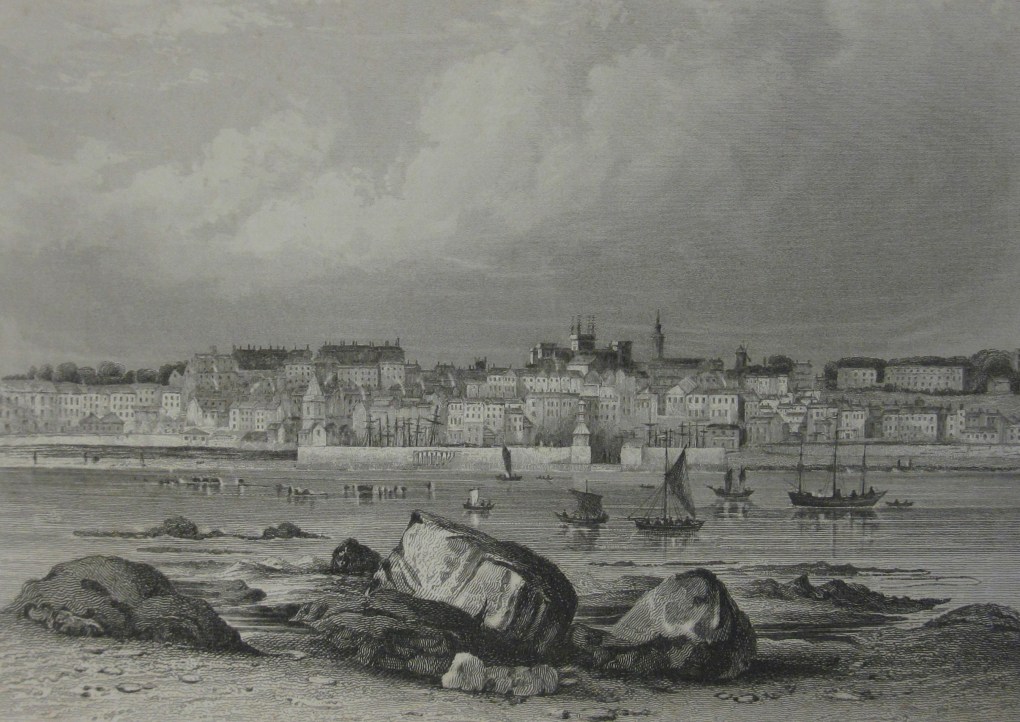
Marie was born in London and married Roland Touzeau (1708-1783) in a church established by the Huguenot community in Leicester Fields, London (now better known as Leicester Square and Soho), in 1739. Roland was born and grew up in St. Peter Port on Guernsey, and was a member of a large Huguenot family who hailed from the Saintonge in the Charente area of France.

Marie and Roland had seven children (Nancy, William, Judith, Jeanne, Anne-Marie and Mary – with Anne-marie being my direct descendent). There is very limited detail in the available records about the lives of the family in London, and what I have found challenges my very rudimentary conversational French. But what we do know is that the family left London to spend a short time in St. Peter Port around 1742, where Jeanne was born in July. The family are recorded as settling back in England, in Deptford, in around 1744. I do wonder what led to the family heading to Guernsey and why this was for such a short time – was the intention to have Jeanne with the support of Roland’s family, or, more likely, was the family in Guernsey to support Roland’s aging mother? Why didn’t they return to Leicester Fields and chose (did they choose?) to live in Deptford? Hopefully I can find further detail in my ongoing research. Both Marie and Roland died in Deptford, with Roland passing in 1783, 14 years before Marie, suggesting they did not just live in Deptford, they made it their home.
To understand Marie’s life more fully, I must indulge in a brief historical detour to set the scene. I assure you I shall do my utmost to keep it engaging, though past performance suggests a certain drift toward the overly enthusiastic.
Between 1500-1750, the Huguenots – French Protestants and followers of Calvinist teachings – were out of favour in a staunchly Catholic France. While they were granted a measure of tolerance under Henry IV, such civility proved tragically temporary. By the latter half of the 17th century, King Louis XVI had repealed the Edict of Fontainebleau, which stripped French Protestants, the Huguenots, of their rights. Churches were destroyed. Worship outlawed. Families pressured, harassed, and, in many cases, forced to flee. Their departures were quiet, desperate, and often illegal. Families slipped away under cover of darkness, clutching what little they could carry to take with them to their new life. Marie’s parents were among those who crossed the Channel.
Life for Huguenots in London in the early- to mid-1700s was a careful balancing act between refuge and reinvention. Having fled persecution in France, they found themselves in a part of London that was lively, crowded, and socially mixed – close enough to fashionable society to glimpse its comforts and the ways of “the ton”, but rarely to share in them. Many brought valuable skills in weaving, silk-making, and craftsmanship, and while some prospered, most lived modestly, working long hours in workshops or at home. French would still have been heard in the streets and chapels, and there was a strong sense of community, but also the quiet pressure to adapt, succeed, and not squander the precarious safety England offered – there was tension amongst the different communities in London which at times led to civil unrest. It was, in short, a life shaped by industry, resilience, and the constant negotiation between what had been left behind and what might, with effort, be built anew.

By the time Marie was born, the immediate incivility towards the Huguenot community in England had passed. What remained were its echoes – children and grandchildren of refugees who had rebuilt their lives in England. By the early 18th century, the Huguenots had begun to establish themselves as citizens of England. Names were anglicised, accents softened. French gave way to English in homes and churches. Within a generation or two, many Huguenot families were, for all appearances, indistinguishable from their neighbours.
So, while uncovering these long lost relatives was really intriguing and introduced me to an important area of history for the first time, what was it that made me stop in my tracks on that fateful search of the records?
It was a picture – a portrait no less.
One does not generally expect, when idly exploring one’s family history (with more enthusiasm than method), to stumble upon portraits. Records, certainly: a baptism here, a marriage there, perhaps even the occasional hint of scandal if you’re fortunate. But portraits? That feels like an altogether rarer gift. It is thought that this portrait was painted to celebrate the marriage of Marie and Roland, and rather wonderfully, there is a portrait of Roland by the same artist. Together, they offer something quite remarkable: not just names on a page, but faces, presence, and the faintest sense of a life once vividly lived.
Portraits from this period, even those marking a marriage, were not casual affairs. They were declarations. Statements of identity, respectability, and, dare I say, arrival. This suggests that Marie and Roland settled into their London lives well, and may have even prospered.
A closer look at the portrait may offer further clues. Clothing, posture, even the smallest detail could signal status, aspiration, and allegiance. A Huguenot-descended couple might choose to sit for their portrait in attire that leaned entirely English… or, in subtle rebellion, retain a hint of French elegance. I’d like to think that Marie had a hint of rebellion about her. She shows a certain posture that suggests she knew exactly who she was, even if the World preferred her otherwise.
Centuries later, I find myself studying Marie’s face and, somewhat disconcertingly, catching a glimpse of my own. I have yet to decide whether this is a comfort or a cause for quiet alarm, but it does suggest a certain continuity. There is, I think, a thread running between us, something faint but persistent, and I cannot help but wonder whether my own little streak of rebellion is simply part of the family inheritance, passed down with rather more consistency than the documentation.
While Marie’s life may not have unfolded in the sort of dramatic chapters historians like to pretend are the norm, she nonetheless appears to have played her part in completing a quieter, more enduring transition her family had begun. There is something rather satisfying in that. Less of a spectacle, perhaps, but considerable substance. I am looking forward to continuing to uncover more about her wider family, in the hope of understanding just how fully they settled into their new world, and how deeply they became woven into the fabric of the community they called home.
And so, I arrive, inevitably, to the portrait.

I expected, quite reasonably, to find interesting family history. Instead, I found something warmer, stranger, and unexpectedly reassuring. I cannot help but think Marie would be amused, and perhaps rather pleased, that she has not only been found, but that, many generations on, someone is still curious enough to want to know her story. And so Marie remains, not merely an entry in a record, but a presence I am genuinely glad to have found.





Leave a Reply